AI FOMO?
In the midst of the AI hype, we are being pushed to integrate AI in the software development lifecycle, it makes sense that it is useful, we hear success stories and a lot of FOMO is being pumped by industry giants. This article is trying to ignore the noise and give you a clear 3-step recipe for integrating AI into your SDLC in a way that gives you immediate value. It is not a silver bullet and requires work, but it is guaranteed to work and deliver ROI. Read on!
Your 3-Step Recipe
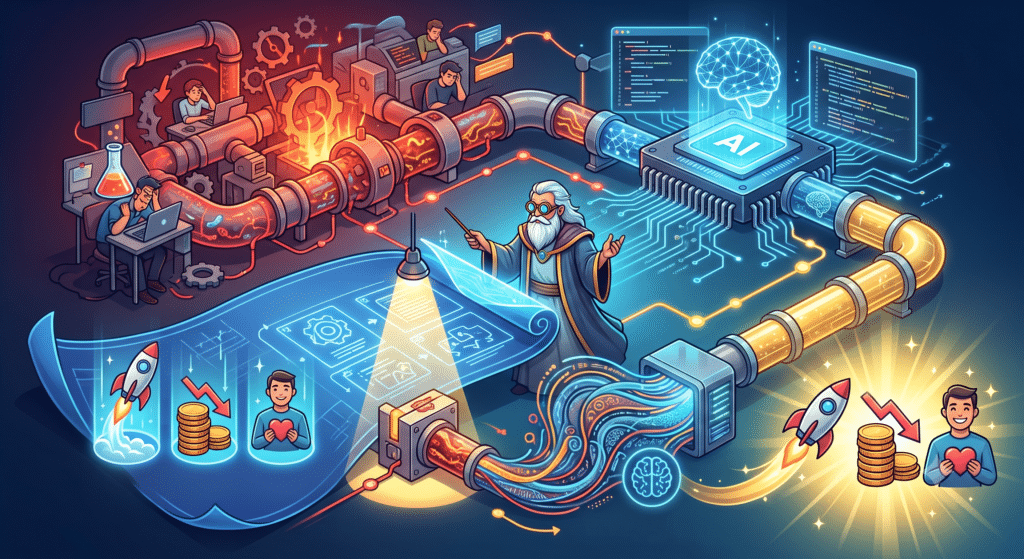
Let’s start with the goal on using AI in the SDLC, there could be only three possible business goals:
Faster Time to Market
Cost Reduction
Higher Customer Satisfaction
So the first step in our 3-step recipe is when you consider using AI in the SDLC or some vendor is trying to sell you some AI agent or content, they need to answer which goal they will achieve for you, faster time to market, cost reduction or higher customer satisfaction. Interestingly, most initiatives to use AI fail this basic question, they can’t connect the dots and show you how the investment leads to any of those three business goals.
The second step in our 3-step recipe is understanding whether the problem we’re trying to solve is worth solving. The initiative, investment or vendor is trying to integrate AI into a specific step in the SDLC, very often coding, sometimes test generation, requirement generation, documentation etc. We need to ask the question: “how effective is the organization working in this phase of the SDLC today”. If code generation or requirement generation is working well today, is not the organization’s bottleneck and can’t be measured to be a bottleneck, then replacing humans (or enhancing humans) with AI capabilities in this phase will not improve the organization as a whole. It will only yield local improvements that will not contribute to any of the three business results above.
The third, and final step in our recipe is understanding whether this phase we’re trying to use AI in, is a data-rich phase where AI has an advantage over humans. AI is at its best when you’re using it to identify patterns, uncover trends and give you insights that will make you more effective. It is less effective when it needs to generate artifacts without enough underlying data. And so, you need to decide if using AI in an SDLC phase, for instance, unit testing, will actually create a solid unit test framework or will generate a bunch of tests that run, pass and provide very little added value to your confidence in releasing the software.
Final Thoughts – From Good to Great
We’re done. Not so easy to implement but very clear, here’s the 3-step recipe again:
Which business problem will be solved by integrating AI into the SDLC?
Is this phase in the SDLC the right choice? Is it underperforming today?
Is this phase in the SDLC, one that AI can outperform humans?
If there’s a good answer to those questions then this investment is justified and you should definitely do it. If not, it’s just noise, keep searching…
Hope that makes sense, if you like this and need help in implementing this recipe, reach out, we are here for you!
Thanks for reading.