Code Review Escapes?
Welcome to this week’s newsletter!
As more organizations adopt AI to accelerate software development, the role of the developer is rapidly shifting from writing code to reviewing code generated by AI. While AI will always win on speed, the ultimate goal of your SDLC is measuring and delivering quality. Today, we are going to talk about why ensuring high-quality code reviews is more critical than ever in an AI-driven environment, and how you can measure your review effectiveness to keep technical debt in check.
The New Bottleneck: Governing AI Output
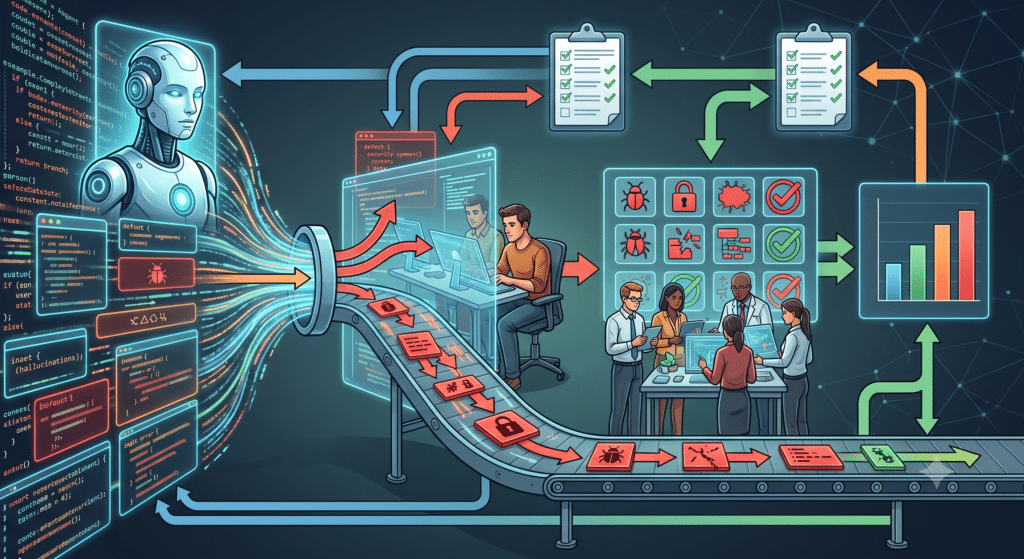
When you introduce AI agents to write your code, the code review phase becomes one of the only mandatory quality gates left to govern the AI’s output. If you simply ask your developers to review AI-generated code without a quantifiable way to measure how well they are reviewing it, you risk letting hallucinated logic, security vulnerabilities, or unmaintainable code slip into your master branch.
In fact, measuring code review effectiveness is almost the only way to benchmark human-written code versus AI-generated code safely. But how do you know if your code review process is actually effective? If you ask a team if they do good code reviews, they will likely describe their process (e.g., checking off a list or using a specific tool), but following a process only guarantees repeatability, not quality.
The Solution: Measuring Code Review Escapes
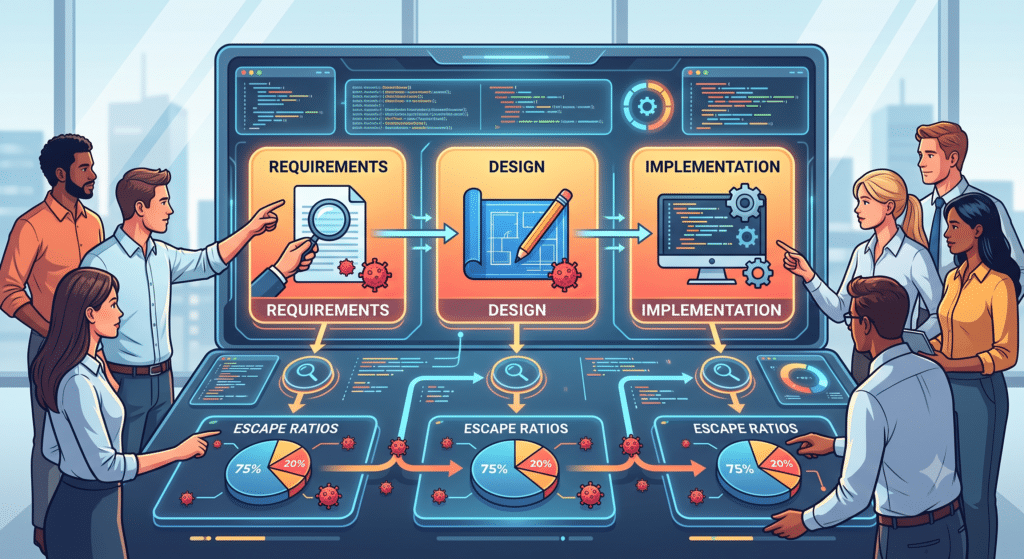
To quantify the effectiveness of your code reviews, you must use a “fast lagging indicator” known as the Code Review Escape Ratio. Here is a simple, highly effective method to calculate this metric:
At the end of each iteration, look at the stream of defects found in testing and randomly select 10 of them.
Gather a team of experts and ask one critical question for each defect: “Could this have been detected with a better code review?”.
Do not dismiss this question easily—only rare issues like race conditions or strange environmental bugs are truly undetectable in a thorough review.
If the answer is “yes,” label it a “code review escape”. If 6 out of 10 defects could have been caught, your code review escape ratio is 60%.
Moving to Level C (Controlled) and Level B (Good)
Within the BetterSoftware framework, implementing this measurement is the first step toward software engineering excellence.
To reach Level C (Controlled) maturity, your team must consistently track this code review escape rate across iterations and demonstrate a flat or downward trend. You must treat every escape as an opportunity to ask: “Why did we miss it?”. The answer usually points to a process gap—perhaps the checklist was incomplete, or the right senior developer wasn’t involved.
To elevate your team to Level B (Good), you must master the “Fixed at Injection” principle. Escapes should become rare because issues are proactively fixed before the code is ever merged. At this level, your CI pipeline blocks merges unless code review checklists are strictly completed, and whenever a defect does escape, you immediately investigate the root cause in retrospectives and tweak your review tools and checklists to prevent it from happening again.
The Bottom Line
When AI generates your code, human reviewers are your safety net. If you don’t know your code review escape ratio, you cannot honestly improve your review process over time, nor can you accurately justify the ROI of your AI tools.
If you want to formally establish your Code Review Escape Ratio, benchmark your AI-generated code against human baselines, and safely scale AI across your SDLC, reach out to the team at BetterSoftware. We can help you implement measurable quality gates that guarantee R&D savings and higher quality releases.
Until next week, keep measuring what matters!