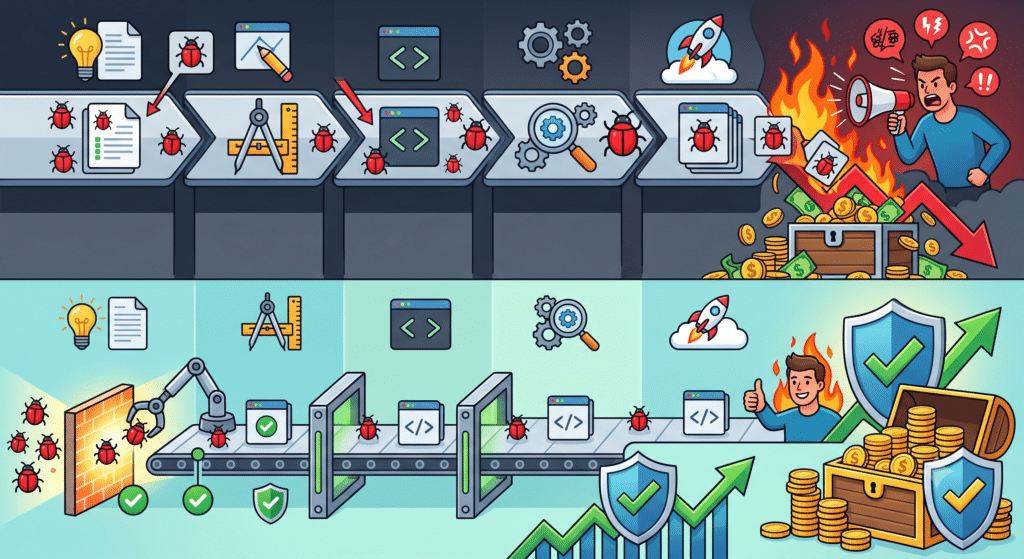
The Exponential Cost of Delayed Detection
Most software organizations are stuck in a cycle of continuous improvement that doesn’t actually tie back to business success—a phenomenon known as “improvement theatre”. They implement new tools or Agile ceremonies but fail to address the core mechanical flaw in their process: the gap between injection and detection.
The true cost of a software problem is calculated by the gap in time between its point of injection (where it was created) and its point of detection (where it was found) and it is exponential.
If a coding problem is injected by a developer and detected a few days later during a thorough code review, the cost is almost negligible. However, a weak quality gate allows defective pieces of work to silently pass to the next station in your delivery pipeline. For example, if a faulty requirement escapes the initial review phase, it will proceed through design, coding, testing, and deployment. The defect is only detected when the customer finally uses it and says, “That’s not what I wanted,” forcing the entire implementation cycle to start over.
The Solution: Acceptance Criteria and Quality Gates
To stop this compounding technical debt, you must build strong quality gates that block defective work from moving to the next station. In a world-class SDLC, every activity starts with an acceptance criteria and ends with a quality gate.
Within the BetterSoftware framework, reducing customer escapes requires advancing your team’s maturity through rigorous measurement and upstream gating:
Moving to Level C (Controlled): At this level, you stop flying blind. Your team must measure specific escape ratios (such as Requirement Escapes or Code Review Escapes) and prove that the trend is flat or improving over time. For instance, if the number of code review escapes increases, the team actively reacts to the deviation by revising their code review checklist to defend against those specific escapes.
Mastering Level B (Good) & The “Fixed at Injection” Principle: To truly slash customer escalations, you must master the “Fixed at Injection” principle. At this maturity level, defective work is actively blocked from moving downstream. If a defect is found, it is treated as a hard blocker. For example, CI pipelines reject code that introduces excessive complexity, or deployments halt immediately upon failure. Because issues are caught at their origin, defects spend less time in the system, context is fresh in the developer’s mind, and the cost of resolution drops dramatically.