Exclusive Early Access Inside
Welcome to this week’s newsletter!
Over the last 18 months, there has been massive pressure on engineering leaders to integrate AI into every corner of the Software Development Lifecycle (SDLC). From AI-assisted code generation to automated requirement drafting, teams are adopting these tools at breakneck speed. However, most organizations are making these investments based on fashion and “gut feel” rather than hard, empirical data.
The hard truth is that while AI changes how software is built, it does not change what good means. If you are not actively measuring the effectiveness of your AI tools across different SDLC phases, you are highly likely falling into the “Code Generation Trap”
The Code Generation Trap: More Code, Less Progress
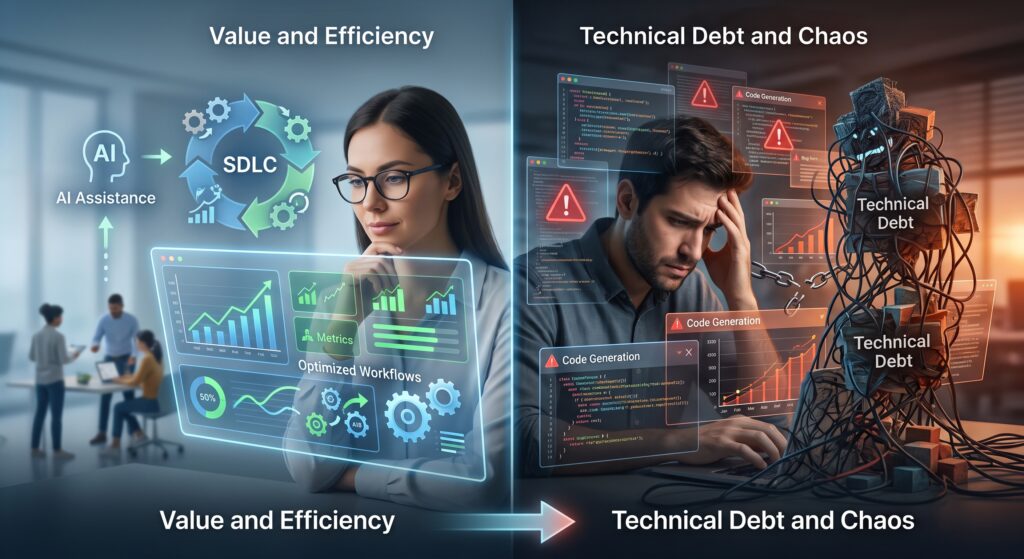
Data shows that while individual developer Pull Requests (PRs) increase by up to 98% after adopting AI coding assistants, overall organizational software delivery actually drops by 1.5%. Why? Because teams are optimizing for the easiest step to automate—raw code creation—without putting proper downstream quality gates in place.
Unmanaged AI-generated code leads to a “one-degree sailing deviation”. A tiny, unverified error injected early in the cycle compounds over time, making debugging take up to 80% longer and rapidly inflating your technical debt. Real progress is not about how many words or lines of code your developers can generate; it is about delivering a piece of code that works, is tested, and generates actual business value.
How to Measure AI Effectiveness in Your SDLC
To safely scale AI without losing engineering control, you must establish an objective measurement system. Rather than guessing, the BetterSoftware framework guides you to evaluate AI under the same rigorous standard as human-led processes:
Define a Clear Quality Gate: Identify the exact SDLC phase you want to automate (e.g., Code Reviews or Requirements) and define a measurable gate, such as the Code Review Escape Rate or Requirement Escape Ratio.
Establish a Downstream Human Guardrail: Ensure that any AI activity is strictly reviewed by human engineers before it progresses downstream.
Benchmark Performance: Measure the AI’s output against your human baseline on three key dimensions: Cost (labor vs. token cost), Time to Completion, and Accuracy (number of defects escaping the quality gate).
Phase Out Human Drafting Gradually: Only when the AI consistently outperforms the human baseline under your strict quality gates should you shift reliance to the automated model
A Major Announcement: Exclusive Early Access for Our Subscribers
To help engineering organizations systematically answer the question of how well they are using AI, we have partnered with Comparative Agility to build the industry’s first Software Engineering Excellence Assessment for AI.
This joint offering is scheduled for a broad public launch this September. You can read more about the upcoming launch on LinkedIn here.
However, because you are a valued member of our newsletter community, we are offering you exclusive early access to this assessment starting today.
By participating in this early access group, your team will get the unique opportunity to:
Benchmark your AI maturity across requirements, review, testing, and maintenance before the rest of the market.
Generate an immediate, data-driven heatmap showing exactly where AI is accelerating your team and where it is compounding technical debt.
Identify and eliminate bottlenecks to ensure your R&D budget is focused where it delivers the highest return.
Don’t wait for the public launch in September. Secure your competitive advantage and gain absolute control over your AI strategy today.
Reply to this mail to claim your exclusive early access code and start your AI SDLC assessment now.
Until next week, keep measuring what matters!