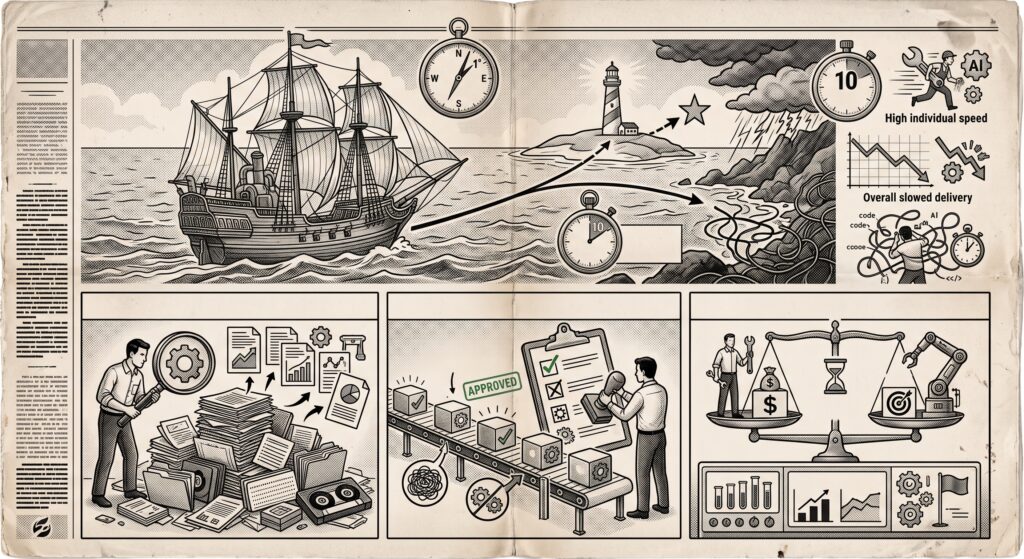
The 1-Degree Deviation
Welcome to this week’s newsletter!
When engineering leaders first roll out AI tools, the promise of near-instant speed is incredibly alluring. But if you let AI tools run wild without guardrails, you risk falling into what we call the “Code Generation Trap”.
While individual developer Pull Requests (PRs) often surge by 98% after adopting AI assistants, overall organizational software delivery actually drops by 1.5%. Because unmanaged AI code generation removes the natural human thinking loop that occurs when translating requirements, debugging times end up taking up to 80% longer.
Think of it like a ten-day journey to a remote island: deviating by just 1 degree each day feels minor on day one, but by day ten, you will have missed the destination entirely. AI changes how software is built, but it does not change what good means.
If you want to extract maximum speed from AI without driving your Software Development Lifecycle (SDLC) into chaos, you must implement these 3 proven, data-backed strategies:
1. Target Pattern-Detection Over Raw Creation
The most common mistake is automating the easiest step, raw code generation, rather than the most wasteful bottleneck. AI is fundamentally a pattern-recognition engine, meaning it thrives in high-data, structured operational workflows. Instead of relying on generic text generation, get real velocity by deploying AI where it can process massive datasets safely:
Defect Root-Cause Analysis: Train AI models on thousands of legacy Jira bugs to find systemic design or process issues humans cannot easily see.
Requirements Review: Rather than asking AI to write requirements from scratch, feed it your historical requirements and customer support complaints. Ask it to cross-reference new requirements against OKRs and past failure logs to spot omissions and contradictions before development begins.
Dynamic Code Review Checklists: Use AI to scan incoming defects and automatically suggest custom checklists for reviewers so they can focus on high-risk modules.
2. Install Downstream Human Guardrails (The “Fixed at Injection” Rule)
To prevent AI-driven errors from silently rolling downstream, every AI-assisted activity must start with an acceptance criteria and end with a strict human-in-the-loop quality gate.
If your team uses AI to draft software requirements, those drafts cannot enter a sprint until a human analyst validates them against a formal quality checklist covering clarity, dependencies, and testability.
If your team uses AI for code generation, a human-led Code Review remains your mandatory quality gate. The review must measure maintainability, code duplication, and static analysis violations, refusing to merge any AI-generated code that degrades these metrics.
3. Implement Objective “AI vs. Human” Benchmarking
Never scale your AI tooling based on speculation or vendor promises. Run a controlled pilot program where you assign the AI agent roughly half of the workload and benchmark its performance against human engineers on three distinct dimensions:
Cost: Compare the labor hours spent by human engineers against the infrastructure and token costs of the AI.
Time to Completion: Track how long it takes each group to meet your pipeline’s definition of done.
Accuracy (Yield): Measure the exact escape rates, how many defects from human-drafted or AI-drafted work were caught downstream by your human guardrails.
Only when the AI consistently and safely outperforms your human baseline under your existing quality gates should you gradually reallocate your human team to more complex engineering tasks
Ready to Benchmark Your AI Maturity?
If you want to stop guessing and start measuring exactly where AI is helping or hurting your software engineering pipeline, we have some exciting news.
This September, BetterSoftware is partnering with Comparative Agility to launch the industry’s first Software Engineering Excellence Assessment for AI.
This structured, data-driven assessment will give you an objective heatmap of your technical practices across requirements, architecture, coding, and testing. It will allow you to confidently identify bottlenecks, measure your AI ROI, and make process improvements that pay for themselves.
As a valued newsletter subscriber, we want to invite you to our exclusive early-access pilot program. Be the first to benchmark your engineering effectiveness and gain complete control of your AI strategy before the public launch next month. Reply to this newsletter to let us know you’re interested and we’ll provide the access.
Until next week, keep measuring what matters!