Master the analysis of Problem Inflow
Welcome to this week’s newsletter!
When software engineering organizations struggle with late releases, pressured R&D budgets, or customer escalations, executive leadership often responds by launching new initiatives or purchasing faster developer tooling. However, these improvement approaches rarely fix the underlying software factory.
The root cause of R&D waste is almost always structural: It is hiding in plain sight between where defects are created and where they are found.
To gain quantitative control over your engineering delivery and dramatically lower your cost of non-quality, you must understand and manage the relationship between Injection Points and Detection Points
Read on!
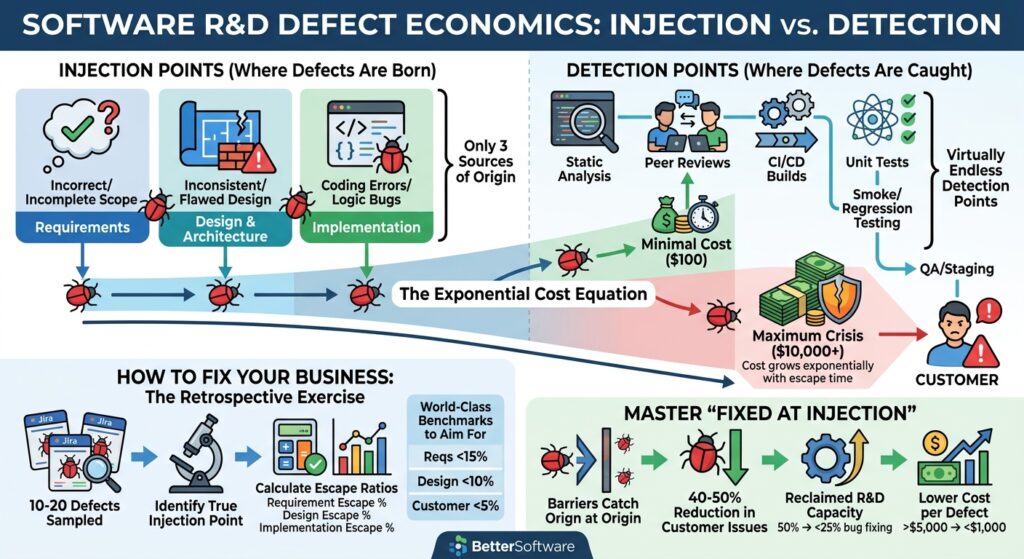
The 3 Injection Points vs. Endless Detection Points
To manage your delivery pipeline like a modern factory floor, you must separate where defects originate from where they reveal themselves:
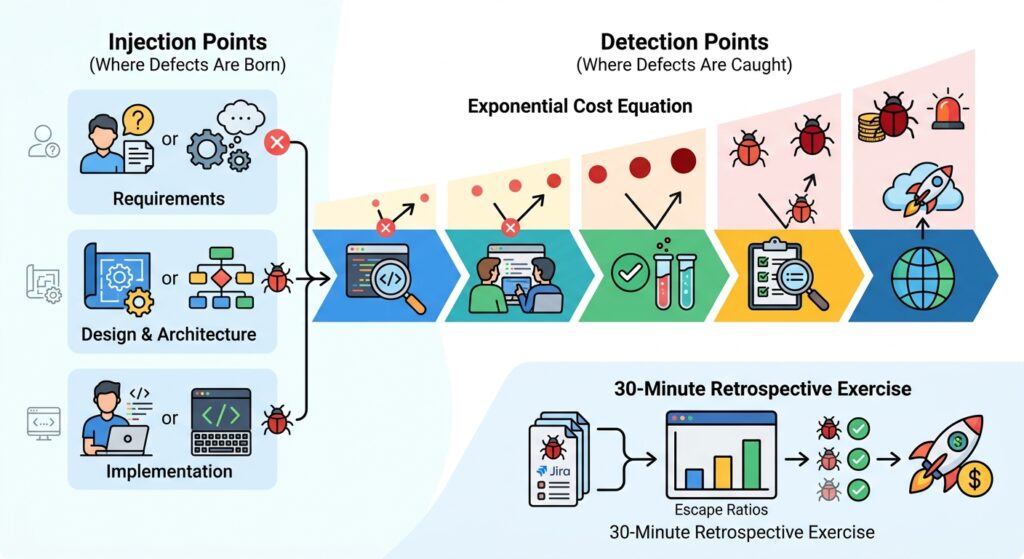
- Injection Points (Where Defects Are Born): In the software development lifecycle, a defect can only be created in three specific phases:
- Requirements: Incorrect, misleading, incomplete, or unapproved scope.
- Design & Architecture: Inconsistent, unscalable, or flawed structural design.
- Implementation: Coding errors, logic bugs, or syntax mistakes.
- Detection Points (Where Defects Are Caught): These are the inspection stations across your pipeline where a defect is discovered. Unlike injection points, detection points are virtually endless, ranging from static analysis, peer code reviews, and CI/CD unit builds, to smoke tests, qualification testing, staging, and ultimately, the end customer.
The Exponential Cost Equation
The price tag of any software bug is dictated by the gap in time between its point of injection and its point of detection, and that cost grows exponentially the longer the bug “lives” in the system.
When a bug survives undetected, it compounds: it contaminates the mainline codebase, impacts other developers, triggers duplicate investigations, and forces context-switching weeks or months later.
Consider the economic extremes:
- Caught at Injection (Minimal Cost): A developer writes a piece of code, introduces a logic error, and catches it a few hours later during a peer code review or a pre-merge CI check. The cost is negligible—no other developer was exposed to it, context is fresh, and it is resolved on the spot without ever being logged as a formal defect in Jira.
- Caught by the Customer (Maximum Crisis): A flawed requirement is approved without proper validation. It moves through design, coding, testing, and deployment before reaching production. When the customer finally uses it and says, “That’s not what I asked for,” the business suffers reputational damage, emergency hotfixes, and must re-run the entire SDLC from scratch. A bug caught at review costs $100; that same bug escaping to production easily becomes a $5,000 to $10,000+ customer escalation.
How to Fix Your Business: The 30-Minute Retrospective Exercise
You do not need an expensive overhaul to start identifying where your R&D budget is leaking. You can run this simple retrospective exercise with your engineering leads at the end of your next sprint:
- Sample 10 to 20 Recent Defects: Fetch a representative sample of bugs opened in your issue tracker during the last iteration.
- Identify the True Injection Point: Have your technical experts examine each bug through a single lens: Where was this problem actually created? (Was it an incomplete requirement, an unscalable design, or a coding error?).
- Calculate Your Escape Ratios: Divide the defects by their injection points to establish your baseline escape ratios:
- Requirement Escape Ratio: The percentage of bugs injected during requirements.
- Design Escape Ratio: The percentage of bugs injected during architecture/design.
- Implementation Escape Ratio: The percentage of bugs injected during coding.
World-Class Benchmarks to Aim For:
- Requirements Escapes: Should be under 10% to 15% of your total bugs. If it exceeds 15%, your team is wasting massive capacity building the wrong things.
- Design Escapes: Should be under 10%.
- Customer Escapes: Defects detected by end customers should be under 5%. (If your internal test cycle finds 1,000 bugs, mathematically about 10%—or 100 escalations—will hit your customers if your internal gates are weak).
Master “Fixed at Injection”
Once you know where defects originate, you stop “spraying” resources on random tools. If requirement escapes are high, you tighten your requirement review checklists and acceptance criteria before code is written. If implementation escapes are high, you strengthen pre-merge code review gates and static analysis rules.
When organizations transition to the “Fixed at Injection” principle, catching and blocking errors at the exact station where they are created—the financial results are immediate:
- 40% to 50% reduction in post-release customer issues.
- Average cost per defect drops from >$5,000 down to <$1,000.
- Reclaimed R&D Capacity: Teams shift from spending 50%–75% of their time fixing bugs down to less than 25%, instantly freeing up 15%+ capacity to build new revenue-generating features without adding headcount.
Stop managing software by gut feel. Identify your injection points, shrink the gap to detection, and make process improvements that pay for themselves!
If you want to run a formal Team Scan to map your effectiveness heatmap across all 35 SDLC competencies, reach out to the team at BetterSoftware.
Until next week, keep measuring what matters!