How Good Is Your Software Organization, Really?
Welcome to this week’s newsletter!
Most software engineering organizations are already successful and fit for purpose. Features get built, releases happen, customers buy, and revenue comes in.
But being fit for purpose is very different from being world-class.
Most engineering leaders have dozens of dashboards telling them what their teams are doing. Far fewer can objectively answer a much more important question:
How effective is our software engineering organization—and how much better could it be?
Here are three indicators that reveal far more than velocity or activity metrics.
Read On!
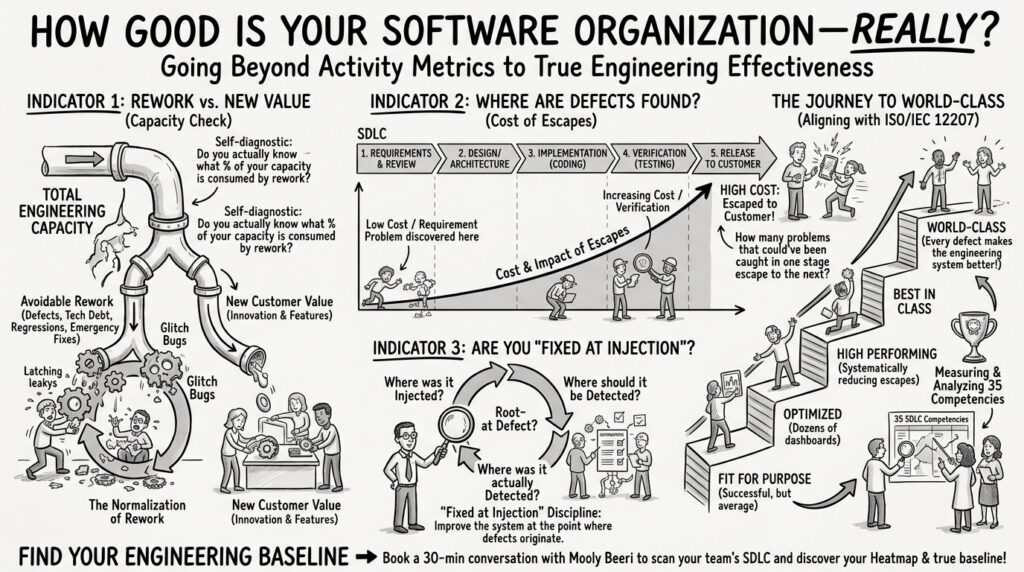
Indicator 1: How Much Engineering Capacity Goes to Rework?
How much of your engineering capacity creates new customer value—and how much is spent correcting work you’ve already done?
Defects, regressions, technical debt, repeated testing, emergency fixes and avoidable rework can quietly consume a significant portion of engineering capacity.
The difference between organizations isn’t whether rework exists. It’s how much rework they allow to become normal.
High-performing organizations systematically move defect detection closer to the point where problems are created. Less rework means more of the engineering organization can work on new value—without adding headcount.
Self-diagnostic: Do you actually know what percentage of your engineering capacity is consumed by rework?
If the answer is no, that’s already an important data point.
Indicator 2: Where Are Your Defects Being Found?
Finding 1,000 defects doesn’t tell you whether your quality organization is good or bad.
Where those defects are found does.
A requirement problem discovered during requirements review is relatively inexpensive. The same problem discovered after implementation is considerably more expensive. If the customer discovers it after release, the organizational cost can become dramatically higher.
That’s why one of the most revealing measures isn’t simply defect volume—it’s escape rate.
How many problems that could have been caught in one stage of your SDLC are instead discovered in the next stage—or by the customer?
World-class engineering organizations don’t just fix escaped defects. They systematically reduce the probability of the same class of defect escaping again.
Indicator 3: Are You “Fixed at Injection”?
A defect discovered in testing may have originated much earlier—in requirements, architecture/design or implementation.
So measuring the testing organization alone misses the point.
For every significant defect, ask:
Where was it injected? Where should it have been detected? Where was it actually detected?
That gives you escape ratios for requirements, design, implementation, verification and ultimately the customer.
World-class organizations then apply a “Fixed at Injection” discipline: when something escapes, they don’t just fix the defect. They improve the process, checklist, automation or quality gate at the point where it originated.
The result is simple:
Every defect becomes an opportunity to make the engineering system itself better.
So Where Does Your Organization Stand?
BetterSoftware evaluates 35 core SDLC competencies, aligned with ISO/IEC 12207, to determine where an engineering organization sits on the journey from Fit for Purpose → Optimized → High Performing → Best in Class → World Class.
The interesting part isn’t receiving a grade.
It’s discovering that an organization can be world-class in some areas, average in others—and that a surprisingly small number of bottlenecks may be responsible for a disproportionate amount of lost engineering effectiveness.
Find Your Engineering Baseline
The BetterSoftware Team Scan provides an objective, quantitative assessment across all 35 SDLC competencies, producing an Effectiveness Heatmap and identifying the highest-impact opportunities separating your organization from its next level of performance.
The question isn’t whether your software organization is good.
It’s how much better it could be.
→ Book a 30-minute conversation with Mooly Beeri to see how your organization compares
Until next week, keep measuring what matters