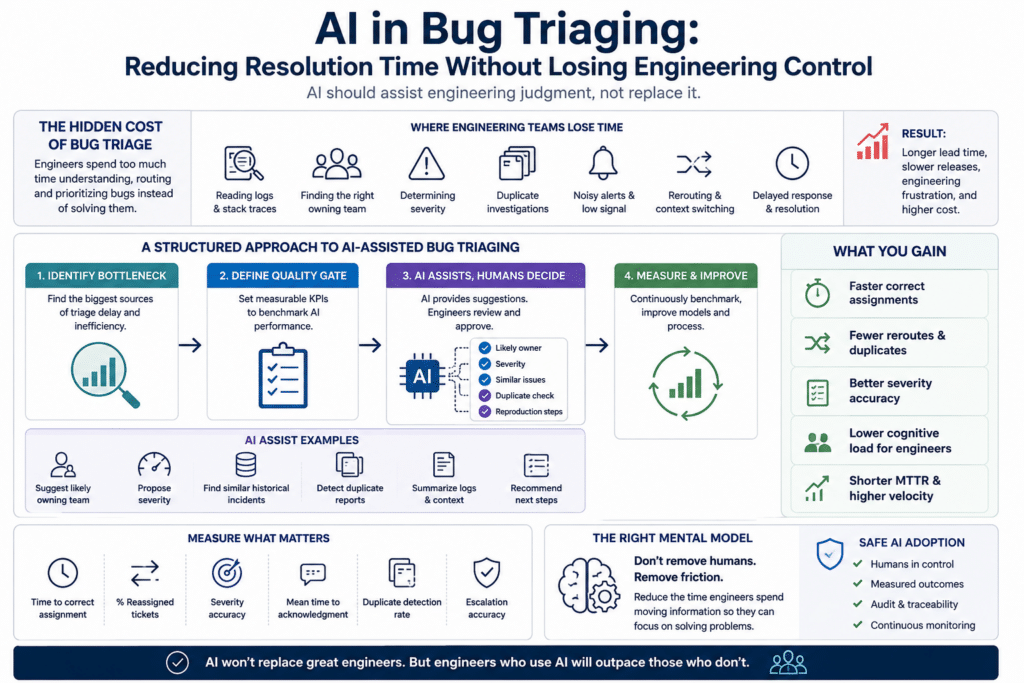
The Hidden Cost of Bug Triage
Most engineering leaders think bugs are expensive because fixing them takes time.
In reality, a significant portion of the cost comes much earlier:
- identifying ownership
- understanding severity
- reproducing the issue
- separating signal from noise
- prioritizing correctly
- routing the bug to the right team
In large enterprise environments, especially in Healthcare and Automotive, bug triaging becomes a bottleneck long before engineering capacity does.
And unlike code generation, bug triaging is an area where AI can provide value with relatively low operational risk.
The question is not whether AI can replace engineers in triage.
The question is:
Can AI reduce the cognitive overhead and latency of triaging bugs while keeping humans in control of engineering decisions? read on!
Why Bug Triaging Is a Strong Candidate for AI
Bug triaging has several characteristics that make it particularly suitable for controlled AI adoption:
- high repetition
- structured data
- measurable outcomes
- bounded decision space
- existing human verification loops
A triage process usually includes:
- logs
- stack traces
- historical incidents
- ownership mappings
- severity definitions
- known failure patterns
This creates a strong environment for AI-assisted classification and recommendation.
Unlike AI-generated production code, the impact of a triage recommendation is:
- reviewable
- reversible
- measurable
This is important in regulated industries where operational safety matters more than raw velocity.
Where Engineering Teams Lose Time
Most triage inefficiency does not come from technical complexity.
It comes from:
- assigning bugs to the wrong team
- duplicate investigations
- poor reproduction steps
- noisy monitoring alerts
- incorrect severity classification
- unclear ownership
- context switching between teams
Over time, these delays create:
- longer lead time
- slower releases
- delayed incident response
- engineering frustration
- lower operational predictability
AI can help reduce this latency.
But only if deployed carefully.
A Structured Approach to AI-Assisted Bug Triaging
Step 1: Identify the Current Bottleneck
Before deploying AI, determine where triage currently breaks down.
Examples:
- too many unresolved tickets
- long assignment delays
- excessive rerouting
- delayed severity assessment
- high MTTR caused by poor initial triage
Avoid deploying AI because it is fashionable.
Deploy it where there is measurable operational pain.
Step 2: Define a Measurable Quality Gate
This is the most important step.
Without a measurable quality gate, AI performance becomes subjective.
Examples of useful triage KPIs:
- time to correct assignment
- number of reassigned tickets
- severity classification accuracy
- mean time to acknowledgment
- duplicate ticket detection rate
- incident escalation accuracy
- false-positive rate
The goal is not “AI usage.”
The goal is measurable operational improvement.
Step 3: Deploy AI Alongside Humans
Initially, AI should assist rather than replace.
Examples:
- suggesting likely owning team
- proposing severity
- identifying similar historical incidents
- summarizing logs
- clustering duplicate reports
- recommending reproduction paths
At this stage:
- humans remain accountable
- humans approve final routing decisions
- AI recommendations are benchmarked continuously
This creates a low-risk adoption model.
What Should Be Measured?
Cost
Compare:
- labor hours spent in triage
vs. - AI infrastructure/token cost
In many enterprise environments, the hidden cost of senior engineers spending time routing tickets is significantly larger than expected.
Time to Resolution
Measure:
- reduction in assignment latency
- reduction in rerouting
- reduction in triage backlog
- reduction in mean time to response
This is often where the largest operational gains appear.
Accuracy
Accuracy matters differently depending on industry context.
Examples:
- severity classification correctness
- ownership accuracy
- escalation appropriateness
- percentage of tickets requiring reassignment
In Healthcare or Automotive:
- a false negative may be extremely expensive
- incorrect prioritization can become a safety issue
This means optimization should favor reliability over raw speed.
Different Industries Optimize Differently
Consumer Software Organizations
May prioritize:
- speed
- throughput
- rapid response
In these environments, AI can aggressively optimize triage velocity.
Regulated Industries
Organizations in:
- Automotive
- Healthcare
- Aerospace
- Finance
usually optimize for:
- traceability
- correctness
- auditability
- operational predictability
In these cases:
- human review guardrails remain critical
- AI should support engineering judgment rather than replace it
The Right Mental Model
The goal is not:
“Remove humans from bug triaging.”
The better model is:
“Reduce the time engineers spend moving information instead of solving problems.”
That distinction matters.
AI is often most valuable in:
- classification
- summarization
- correlation
- prioritization
not necessarily final decision-making.
When Should Humans Be Phased Out?
Only after:
- measurable benchmarking
- long-term consistency
- stable quality metrics
- proven operational reliability
Even then, organizations should:
- retain monitoring
- periodically audit outcomes
- continue benchmarking AI decisions against human baselines
This is especially important because:
- systems drift
- products evolve
- incident patterns change over time
AI performance is not static.
Final Thoughts
Most enterprise engineering organizations are approaching AI adoption backwards.
They start with:
- code generation
- autonomous development
- full automation ambitions
But some of the safest and highest-ROI opportunities exist much earlier in the operational workflow.
Bug triaging is one of them.
Not because AI replaces engineers.
But because it reduces the friction that prevents engineers from focusing on actual engineering work.
And in large-scale SDLC environments, reducing friction is often more valuable than increasing raw coding speed.