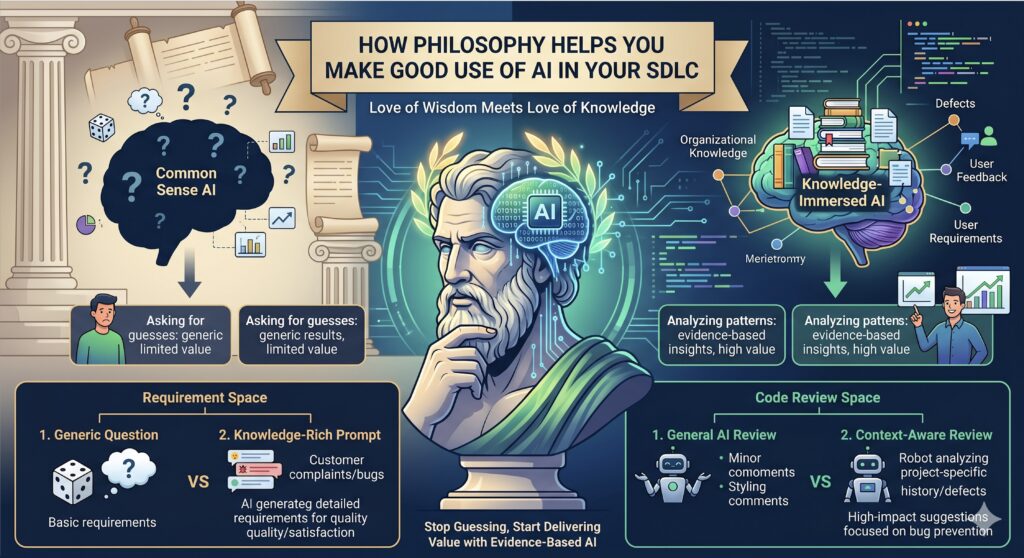
If you’ve ever studied Philosophy, you know it’s about thinking deeply about the fundamentals of existence and knowledge. Applying some of those principles in the deployment of AI in your Software Development Lifecycle (SDLC) yields surprising results.
Once you start thinking seriously about what AI is fundamentally about it becomes infinitely easier to get value from it.
Let me show you how, read on…
Why does AI Thrive on Knowledge?
Literally, Philosophy is the love or wisdom, love of knowledge. AI thrives on knowledge, it is in essence a piece of sophisticated software that can predict what the best next thing to say is, based on all available knowledge. Without knowledge, AI’s predictions have no substance (those are sometimes called hallucinations). With knowledge, it exceeds the human capability of predicting the right direction.
And so, to get the most of any AI based technology, you have to feed it with your organizational knowledge. Using AI to generate any artifact along with SDLC based on its ‘common sense’ will not generate anything better than a dice roll (perhaps quicker than a dice roll)
Let’s take two examples of using AI in the software requirement space.
You can ask an AI agent to ‘generate the requirements for new features that will increase revenue for the business’. What you get is generic responses, assuming you have a digital business and you need to leverage common paths such as pricing, engagement, retention. You will get a set of requirements very quickly but will they really help you? Quite unlikely
On the other hand, you can give an AI agent your full set of requirements, your full set of defects and customer complaints logged over the last few years and ask it ‘what features am I missing to minimize the number of defects and increase customer satisfaction’. Now the AI agent shifts from guessing to analyzing patterns, in which it is much better than us. What you get is a set of requirements that is evidence based and pattern based. Implementing any of those will directly improve your bottom line.
In both cases, you’re asking AI for requirements that will improve business performance, but in the second case, you are immersing it in knowledge and getting the right value from it.
Let’s take two other examples of using AI, this time in the Code Review space.
You can ask an AI agent to ‘review the code for correctness, act as a code reviewer’. Again, you’ll get very quickly a set of observations, but the AI agent is giving you general feedback based on every piece of data it has ever found on any code review ever performed. Is it right for your context? Does it help your business if you implement all recommendations? Quite unlikely
On the other hand, you can give the AI agent the full record of all code reviews performed in the team in the last years, with every comment made. Provide it with the full set of defects found in testing and ask it ‘review the code based on the standard in the team as seen in the previous code reviews and provide only comments that are highly likely to minimize the number of defects found in this piece of code by analyzing all existing defects’. You immerse the AI agent in knowledge of your environment and immediately make the linkage between the comments you get and business results. The AI agent stop guessing and starts finding patterns and helping you avoid common pitfalls which have actually happened before.
In both cases, you’re asking AI to perform code review that will improve code quality, but in the second case, you are immersing it in knowledge and getting the right value from it.
The Bottom Line
We can go on and apply this principle to any phase in the SDLC, there are more than 30 of those but the idea is the same. Asking the AI agent to produce some work or an artifact without knowledge is asking for a wild guess (hallucination) dressed up in quick, nicely phrased responses. Immersing the AI agent in your organization’s knowledge would make it detect patterns, stop guessing and start delivering value.
Once you get the hang of it, you’ll notice how using AI can actually boost your effectiveness.
Enjoy!