Making Continuous Improvement Systematic
Welcome to this week’s newsletter!
Historically, an engineering leader’s role was defined by delivery output: shipping features on time, managing technical roadmaps, and keeping development teams aligned with business priorities.
However, as software systems grow in scale, cost, and operational complexity, delivering features alone is no longer the true test of engineering leadership. Today, executive teams don’t just ask “Did we ship the release?”, they ask “Is our software engine getting systematically more efficient, predictable, and cost-effective over time?”
The highest-performing engineering leaders recognize a fundamental shift: delivering software is the output, but managing the effectiveness of the software factory itself is the primary management discipline.
Read On!
Why the AI Explosion Accelerates This Shift
The urgency of this leadership evolution has been dramatically heightened by the rapid integration of AI across the Software Development Lifecycle (SDLC).
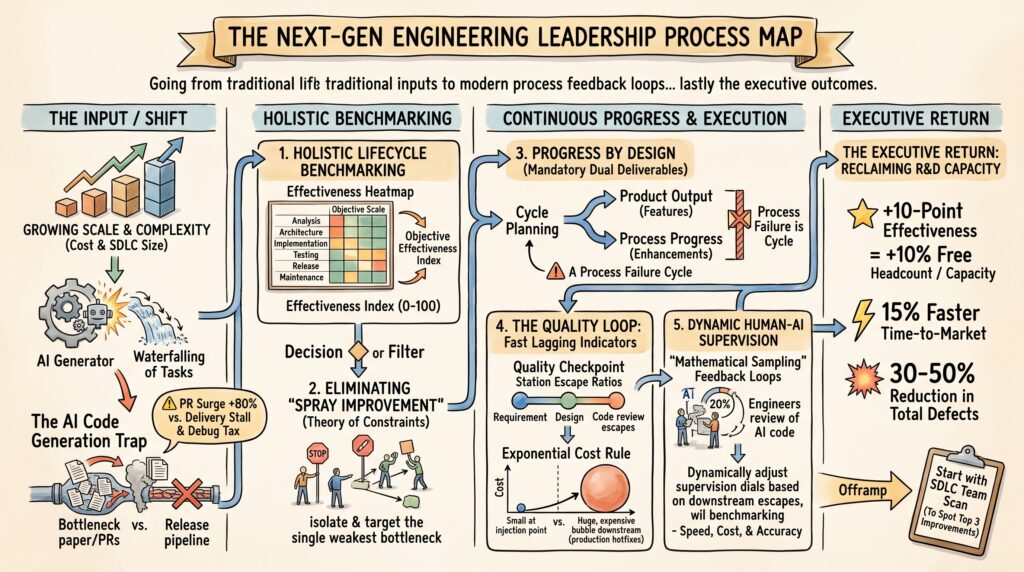
AI coding tools can generate pull requests, boilerplates, and test stubs 5x to 10x faster. But raw code creation is only one station on a complex manufacturing line. When engineering leaders deploy AI without upgrading their overall SDLC controls, they inadvertently trigger the “Code Generation Trap”:
- PR Volume Surge vs. Delivery Drop: Developer activity and pull request counts increase by up to 98%, yet overall organizational delivery stalls or drops.
- The AI Review & Debugging Tax: Unmanaged AI code generation removes the natural “thinking process” developers go through when translating requirements. As a result, synthetic code slips past weak review gates, causing debugging times to balloon by up to 80%.
- Pushed Bottlenecks: Accelerating code writing simply pushes the bottleneck upstream to ambiguous requirements and downstream to code reviews, system verification, and production hotfixes.
AI changes how software is written, but it does not change what good software engineering means. Without a quantitative management framework to measure and govern lifecycle effectiveness, AI investments simply accelerate the accumulation of technical debt.
What The New Management Discipline Looks Like
Next-generation engineering leaders replace gut feel, vanity activity metrics, and “improvement theatre” with a structured, quantitative operating discipline based on five core pillars:
1. Holistic Lifecycle Benchmarking
You cannot manage what you do not measure across the entire system. Instead of tracking superficial metrics like lines of code or ticket throughput, modern leaders evaluate their software factory across a comprehensive spectrum of core technical competencies spanning Analysis, Architecture & Design, Implementation, Testing, Release, and Maintenance.
By rating each competency on an objective maturity scale (from basic tracking up to world-class execution), leaders establish a visual Effectiveness Heatmap and synthesize their pipeline into a single, objective Effectiveness Index score (0–100).
2. Eliminating “Spray Improvement” (Theory of Constraints)
When continuous improvement is unmanaged, organizations fall into “spray improvement”—buying AI assistants, rewriting microservices, adopting new test frameworks, and changing CI tools all at once. This scatters R&D budget without improving overall system throughput.
Engineering leaders apply the Theory of Constraints: they use their SDLC effectiveness map to isolate the single weakest bottleneck currently throttling delivery (e.g., requirement ambiguity or static analysis hygiene) and focus 100% of improvement resources on resolving that specific constraint before moving to the next.
3. Process Progress as a Mandatory Deliverable
In traditional operations, teams spend 100% of their time pushing features out the door while pushing process debt into the future.
Under the new management discipline, leaders enforce Continuous Progress by Design:
- Every development iteration must produce two distinct deliverables: Product Progress AND Process Progress.
- During cycle planning, teams commit not just to feature tickets, but to a specific, measurable process enhancement—such as raising their Code Review effectiveness.
- Delivering features without delivering the committed process enhancement is classified as an incomplete cycle.
4. Fast Lagging Indicators & “Fixed at Injection”
Relying on vanity leading indicators (like test suite counts) or waiting months for slow lagging indicators (like post-release customer surveys) leaves leaders flying blind.
Modern leaders rely on fast lagging indicators—specifically Station Escape Ratios:
- At the end of each iteration, teams audit downstream defects to measure their Requirement, Design, and Code Review Escape Ratios.
- The Exponential Cost Rule: A defect caught at its injection point (e.g., during a peer code review) costs under $100 to fix. That same error escaping to production as a customer incident costs $10,000+ in emergency hotfixes, context-switching, and brand damage.
- When an escape occurs, the team performs a root-cause analysis to strengthen the upstream quality gate, ensuring the software factory permanently improves.
5. Dynamic Human Supervision & AI Benchmarking
Instead of choosing between zero AI controls (production chaos) or 100% manual review (paralyzing bottlenecks), leaders treat human guardrails like a dynamic testing layer.
They establish mathematical sampling feedback loops: reviewing a sample (e.g., 20%) of AI-generated work products and dynamically adjusting the supervision dial up or down based on downstream escape rates. Furthermore, AI agents are benchmarked against human engineers on Cost (tokens vs. labor), Speed, and Accuracy (Yield)—expanding AI usage only when the model consistently outperforms the human baseline under the exact same quality gates.
The Executive Return: Reclaiming Lost R&D Capacity
Applying this management discipline transforms engineering process improvement from an abstract goal into a direct financial driver:
- The 10-Point Capacity Rule: Improving an organization’s baseline Effectiveness Index rating by just 10 points mathematically frees up approximately 10% of total engineering capacity every single year—the equivalent of adding 10% free engineering headcount without hiring a single developer.
- Proven Enterprise Outcomes: Enterprise organizations implementing this model achieve 15% faster time-to-market, a 30% to 50% overall reduction in total defect volume, and a 40% to 60% drop in post-release customer escalations.
Take Control of Your Engineering Effectiveness
Leading a modern software organization isn’t about hoping your developers work harder or hoping new AI tools solve your bottlenecks. It’s about establishing the quantitative controls needed to turn continuous improvement into a predictable, measurable business outcome.
Ready to see how your organization compares against industry benchmarks? You can conduct an objective SDLC Team Scan to evaluate your delivery pipeline across all core technical competencies, generate a visual effectiveness heatmap, and pinpoint your top 3 high-impact improvement opportunities.
http://Book a 30-minute discovery call to explore an objective software engineering benchmark scan.
Until next week, keep measuring what matters