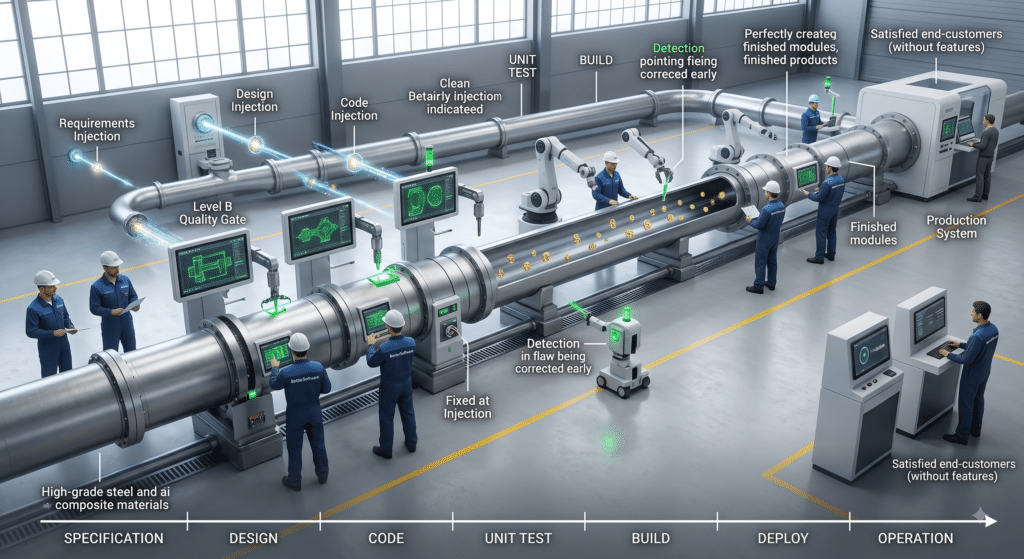
Why the Injection-to-Detection Gap is Ruining Your Margins
Welcome to this week’s newsletter!
When engineering leaders look at their R&D budgets, they often focus on developer salary sheets, tool licenses, or server costs. But the biggest, most silent drain on your budget isn’t a line item on a spreadsheet—it is the time defects spend “living” in your system.
The math of software quality is unforgiving: the cost of a software defect is calculated by the gap in time between its point of injection and its point of detection, and this cost grows exponentially.
The longer a bug survives undetected, the more technical debt it accumulates, and the more expensive it becomes to resolve
The Lifespan of a Defect: From Injection to Detection
To understand how to control this financial bleeding, we must separate where defects are born from where they are found. In the software factory, there are only three possible injection points where a defect can be created:
Requirements (incorrect, misleading, or incomplete scope)
Design & Architecture (poor structure, unscalable data flows, or anti-patterns)
Implementation (actual coding errors or logic bugs)
Conversely, detection points are virtually unlimited. They are the check-points or “stations” across your pipeline where a defect is discovered—such as automated static analysis, unit testing, Continuous Integration (CI/CD) pipelines, qualification testing, or, in the worst-case scenario, the end-customer.
The Time-Gap in Action: Two Scenarios
Let’s look at two extreme examples of how the time a defect spends in the system dictates its final price tag:
The Negligible Cost (Implementation ➔ Code Review): A developer writes a piece of code and introduces a logic error. Within a couple of days, before any other developer interacts with the code, the defect is caught during a peer Code Review quality gate and fixed instantly. The code has spent almost no time in the system, the context is fresh in the developer’s mind, and the cost of resolution is practically zero.
The Astronomical Crisis (Requirements ➔ Customer): A misleading requirement is written but passes unchecked through requirement reviews, system design, coding, testing, and deployment. Weeks or months later, the customer opens the production system, experiences frustration, and escalates the issue: “This is not what I wanted”. Now, your team must freeze progress, trigger an emergency hotfix, and start the entire software development lifecycle over from scratch to fix the core requirement. The average cost of fixing a defect at this late stage can easily exceed $5,000, not to mention the reputational damage and lost development velocity.
The Only Proven Solution: “Fixed at Injection”
The default response for most Agile teams is to run faster on the feature treadmill while trying to write more late-stage automated tests. But this “spray improvement” approach is an expensive illusion of progress that doesn’t fix the underlying factory machinery.
To systematically lower your R&D expenses and eliminate technical debt, you must implement the “Fixed at Injection” principle. Under the BetterSoftware framework, this means installing strong, active quality gates at each phase of the SDLC to catch errors in the exact station where they are created.
When you transition to Level B (Good) maturity, your team stops letting issues roll forward. If static analysis tools flag a violation, or a requirement checklist is missed, the pipeline blocks progress automatically. Defects are detected and resolved immediately at the point of origin before they are ever registered in a bug database.
By systematically shrinking the gap between injection and detection, our clients see their average cost per defect drop from over $5,000 to under $1,000, while freeing up to 25% of their team’s capacity to build new features instead of fixing old mistakes
Final Thoughts
If you are ready to evaluate your lifecycle, install robust quality gates, and stop paying the compounding interest of delayed defect detection, reach out to the BetterSoftware team. We can help you identify your weakest link and make your process improvements pay for themselves from month one.
Until next week, keep measuring what matters!