How Much Better Could Your Software Organization Actually Be?
Welcome to this week’s newsletter!
Most software organizations we encounter are already successful.
Products ship. Customers buy them. Releases happen. Teams function. The business gets what it needs.
We call this “Fit for Purpose.”
And there is absolutely nothing wrong with being Fit for Purpose.
But being successful today tells you surprisingly little about how close your organization is to its potential.
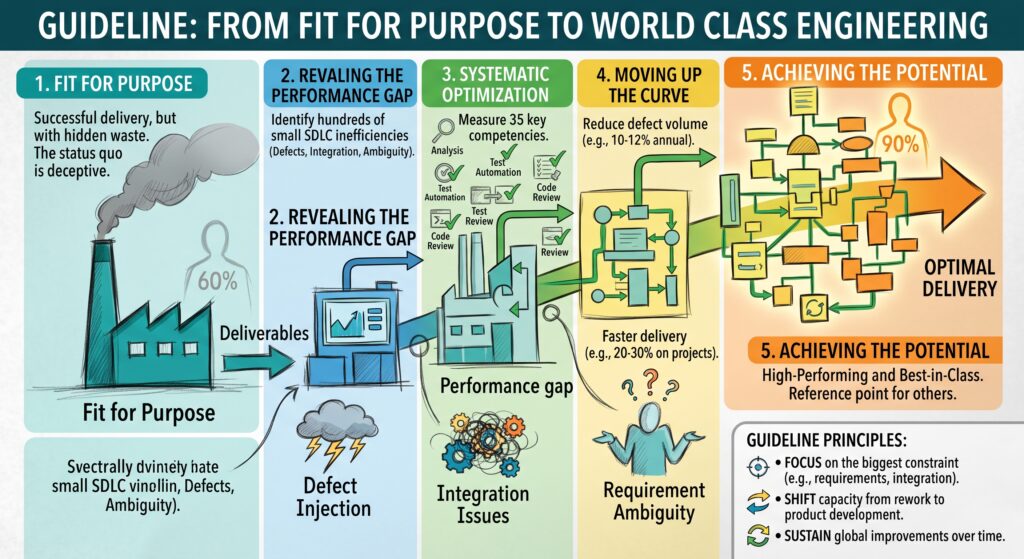
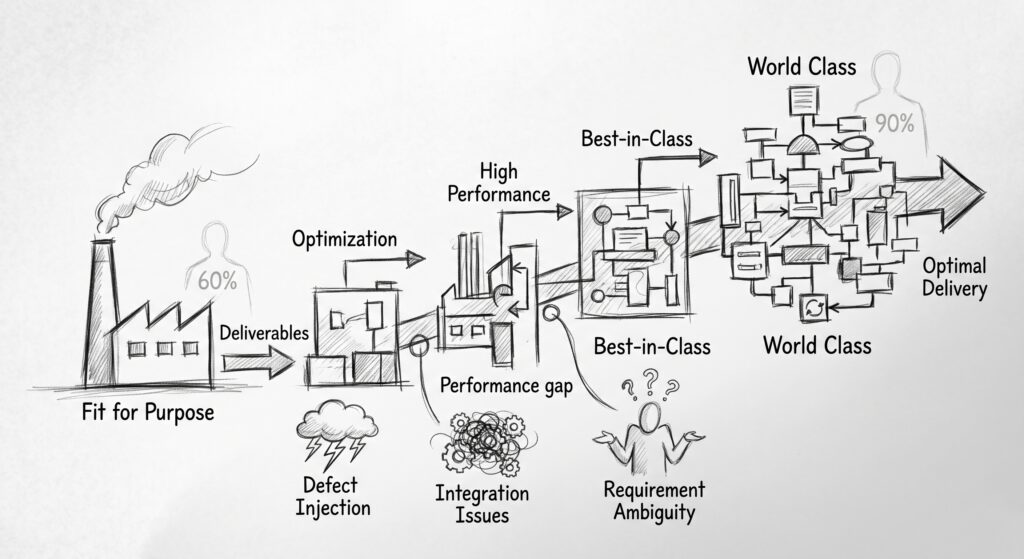
A software organization operating at 60% of its potential and one operating at 90% may both be delivering successfully. From the outside, both may look healthy.
The difference is the amount of performance still available inside the organization.
Which raises a question that is surprisingly difficult for most engineering leaders to answer:
How much better could your existing software organization actually be?
Not with more developers.
Not with a bigger budget.
Not after replacing your technology stack.
With the people, budget and technology you already have.
Success Doesn’t Mean You’ve Reached Your Potential
We tend to evaluate software organizations in fairly binary terms.
Are we delivering?
Are customers satisfied?
Are releases happening?
Are we meeting our commitments?
If the answers are mostly yes, attention naturally moves elsewhere.
But there is an enormous spectrum between “it works” and “this organization is performing close to its potential.”
We describe that progression as:
Fit for Purpose → Optimized → High Performing → Best in Class → World Class
A Fit-for-Purpose organization reliably delivers what the business needs today.
An Optimized organization systematically removes known inefficiencies.
A High-Performing organization consistently delivers superior outcomes.
A Best-in-Class organization performs beyond most of its peers.
And a World-Class organization becomes a reference point others can learn from.
The interesting question isn’t whether your organization is successful.
It’s how much distance remains between where you are and where you could realistically be.
Where Does the Performance Gap Come From?
It usually isn’t one catastrophic problem.
It’s hundreds of small inefficiencies distributed throughout the Software Development Lifecycle.
A requirement ambiguity survives analysis.
A design issue isn’t detected during design.
A coding problem escapes code review.
An integration issue isn’t discovered until system testing.
Teams wait for environments.
Developers investigate problems that should have been prevented.
Released functionality comes back as customer escalations.
None of these necessarily stops the organization from delivering.
They simply make delivery more expensive, slower and less predictable than it needs to be.
That’s why the performance gap can remain invisible for years.
The organization works.
It just doesn’t work as well as it could.
Can You Actually Measure the Gap?
This is where things become interesting.
Instead of asking:
“Are we doing Agile correctly?”
or:
“Are our developers productive?”
we can ask a much more useful question:
How effectively does each part of our engineering system perform—and what is currently limiting the performance of the whole?
At BetterSoftware, we measure 35 engineering competencies across the complete Software Development Lifecycle, covering Analysis, Design, Implementation, Testing, Release and Maintenance.
Each competency is evaluated against a 10-level effectiveness scale.
The result is not simply another maturity score.
It creates a map of the organization showing where engineering practices are already strong, where performance is being constrained, and—most importantly—where improvement has the greatest potential to affect business results.
The Goal Isn’t to Improve Everything
This distinction is important.
Most large software organizations already have more improvement initiatives than they can realistically execute.
There are Agile transformations.
DevOps initiatives.
Cloud migrations.
Quality programs.
Developer-experience projects.
AI coding assistants.
New CI/CD platforms.
Architecture initiatives.
The problem is rarely a shortage of things to improve.
The problem is knowing:
Which improvement will make the biggest difference right now?
If your largest constraint is requirements quality, improving your CI/CD infrastructure may have little effect on overall delivery performance.
If integration is the constraint, improving developer coding speed may simply deliver more software into an already overloaded integration process.
If defects are being injected during design, adding more testing downstream may detect them—but it doesn’t eliminate the source of the problem.
The objective is therefore not to become excellent at all 35 competencies simultaneously.
It’s to understand what is currently preventing the organization from performing better and improve that first.
What Happens When You Start Closing the Gap?
The effect isn’t merely a better process score.
Engineering capacity begins moving away from activities such as rework, late defect correction, stabilization and firefighting—and toward product development.
Defects are discovered closer to where they’re introduced.
Customer issues decline.
Delivery becomes more predictable.
Existing engineering capacity becomes available for additional scope.
And the organization gradually moves from simply delivering software to systematically improving the system that delivers software.
We’ve seen this progression in large enterprise environments.
At Philips, the program produced approximately 10–12% annual reductions in defect volume, 20–30% faster delivery in many projects, lower delivery costs and substantially fewer post-release issues.
At Aptiv, defect volume declined approximately 14–16% annually, post-release issues were reduced by around 50%, and roughly 40,000 defects were eliminated from late project stages.
At Mercedes-Benz Research & Development India, one engagement produced a 90% reduction in defect volume alongside substantial reductions in post-release issues.
The important point isn’t that every organization will produce the same numbers.
It’s that successful organizations can still contain substantial unrealized performance potential.
And That’s Why “Fit for Purpose” Can Be Deceptive
If your software organization were failing, you’d know you had a problem.
The more interesting situation is when it isn’t.
Products are shipping.
Customers are buying.
Management is reasonably satisfied.
Your engineering organization may therefore have no obvious reason to change.
But imagine discovering that the same organization could deliver meaningfully more scope, with fewer defects and lower cost—without increasing headcount.
That’s not fixing a failing organization.
It’s discovering the difference between:
the organization you have
and
the organization you could have.
So, How Close Are You to Your Potential?
That’s the number I’d want to know.
Not whether your software organization is good or bad.
Not whether you’re Agile.
Not whether you’ve adopted the latest engineering tools.
But:
How much better could this exact organization become?
BetterSoftware measures engineering effectiveness across the entire SDLC to establish where an organization is today, identify the constraints preventing it from performing better, and quantify the improvement opportunity.
If you’re curious about how much untapped engineering potential exists in your organization, we can measure it.
Let’s calculate your Effective Engineering Capacity →
Until next week, keep measuring what matters