Making Continuous Improvement Systematic
Welcome to this week’s newsletter!
Most engineering organizations track dozens of metrics—delivery velocity, code throughput, deployment frequency, bug counts, and ticket burndown charts. Yet, if you ask an executive team to objectively answer: “Is our software factory actually getting systematically more effective over time?”, the answer is almost always based on gut feel rather than empirical data.
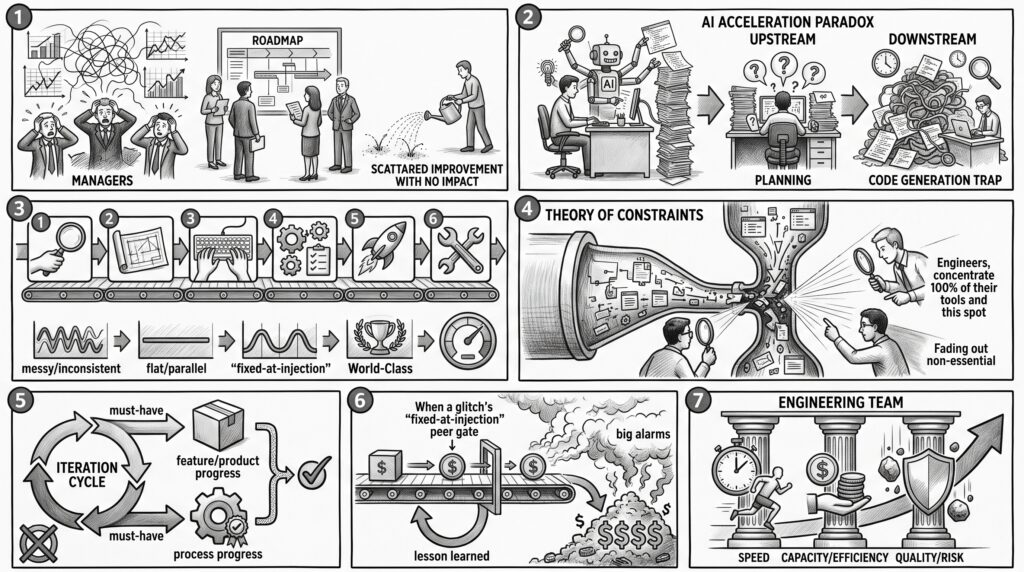
There is a fundamental paradox at the heart of modern software development: traditional delivery frameworks create space for continuous improvement, but they rarely explicitly guide teams on how to measure or achieve it. Without a unified, quantitative measurement system, organizations fall into “spray improvement” (or “improvement theatre”)—spending budget on scattered local initiatives that feel productive but never move the needle on business performance, release quality, or R&D costs.
Read On!
The AI Acceleration Paradox: Why Systematic Improvement is Now Urgent
This challenge has become far more acute with the rapid adoption of AI across the Software Development Lifecycle (SDLC).
While AI coding tools can generate pull requests and raw implementation code 5x to 10x faster, accelerating code generation alone does not automatically accelerate software delivery. When teams deploy AI without upgrading their lifecycle controls, they simply push bottlenecks upstream to requirements and downstream to code reviews, verification, and debugging.
Unmanaged AI adoption often leads to the “Code Generation Trap”—where code volume explodes, but debugging time balloons by up to 80% because developers lack deep context over synthetic code. As AI changes how code is written, having a rigorous, quantitative framework to manage engineering effectiveness becomes the only way to capture real AI return on investment without accumulating unsustainable technical debt.
How Industry Leaders Systematize Improvement
World-class engineering organizations treat process improvement not as an informal side discussion, but as a systematic, measurable, and accountable engineering discipline.
Here are the core principles high-performing engineering organizations use to manage continuous improvement:
1. Comprehensive Lifecycle Visibility Across the Entire SDLC
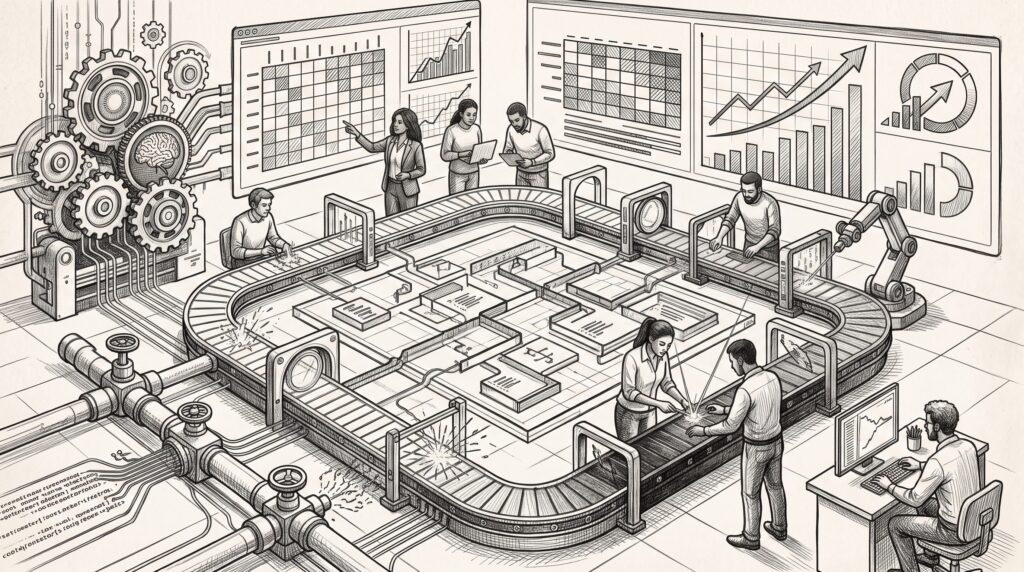
You cannot optimize a complex software factory floor if you only measure one or two inspection stations. World-class organizations gain holistic visibility by evaluating their delivery pipeline across a comprehensive spectrum of core technical competencies spanning Analysis, Architecture & Design, Implementation, Testing, Release, and Maintenance.
Instead of relying on subjective opinions, every competency is assessed against a structured maturity scale:
- Basic Level: Key performance indicators (KPIs) are tracked, but execution is inconsistent and outcomes fluctuate.
- Controlled Level: Primary KPIs are trended across development cycles and proven to be flat or improving.
- Good Level: “Fixed at Injection” discipline is achieved—defects and AI-generated deviations are caught and resolved in the exact lifecycle station where they originate.
- World-Class Level: Secondary metrics are optimized, practices serve as organizational standards, and performance serves as an industry reference model.
Synthesizing these competencies produces a visual Effectiveness Heatmap and an objective overall Effectiveness Score (0–100) for the entire engineering organization.
2. Focus 100% of Energy on the Single System Bottleneck
When continuous improvement is unmanaged, teams attempt to fix everything simultaneously—buying new AI assistants, adopting new test frameworks, and restructuring microservices all at once. This scatters focus and generates localized changes that fail to improve overall delivery.
World-class organizations apply the Theory of Constraints:
- Isolate the Weakest Link: Using their lifecycle heatmap, leaders pinpoint the single constraint currently throttling delivery—whether it is ambiguous requirement specifications, static analysis hygiene, or weak code reviews.
- Direct Improvement Resources: 100% of process improvement bandwidth is dedicated to eliminating that specific bottleneck, ignoring other distractions until that constraint is resolved.
3. Process Improvement as a Mandatory Iteration Deliverable
In standard software operations, teams focus entirely on pushing features out the door while pushing process debt into the future.
World-class organizations enforce Continuous Progress by Design:
- Every development iteration must produce two distinct deliverables: Product Progress AND Process Progress.
- During cycle planning, teams commit not just to feature deliverables, but to a specific, measurable process enhancement—such as raising their Code Review effectiveness rating.
- Delivering features without delivering the committed process enhancement is classified as an incomplete cycle.
4. Fast Lagging Indicators & “Fixed at Injection”
Measuring vanity leading indicators (like lines of code written, PR volume, or test counts) or waiting months for slow lagging indicators (like customer feedback) fails to give actionable guidance.
World-class organizations rely on fast lagging indicators—specifically Station Escape Ratios:
- At the end of each development cycle, teams audit downstream defects and calculate their Requirement, Design, and Code Review Escape Ratios.
- The Economic Rule: The cost of a defect grows exponentially with the time gap between its point of injection and its point of detection. A logic or AI-generated error caught during peer review costs under $100; that same error escaping to production costs $10,000+ in emergency hotfixes, customer disruption, and lost momentum.
- When a defect escapes, the team conducts a root-cause analysis to strengthen the upstream quality gate (checklists, automated CI checks), ensuring the factory machinery permanently improves.
5. Tying Process Improvements Directly to Business ROI
World-class organizations reject “improvement for the sake of improvement”. Every process initiative must meet strict acceptance criteria tied to three core business pillars:
- Time-to-Market: Does this increase feature delivery velocity?
- R&D Cost & Capacity: Does this lower execution cost and eliminate rework waste?
- Quality & Risk: Does this reduce production incidents and customer escalations?
Proven Enterprise Outcomes:
When applied across large-scale engineering organizations, this systematic framework delivers predictable, compounding business returns:
- 30% Overall Defect Reduction: Slashing internal test noise and rework.
- 20–30% Faster Time-to-Market: Accelerating feature delivery with existing headcount.
- 60% Reduction in Customer Escalations: Protecting brand reputation and release stability.
- The 10-Point Capacity Rule: Improving an organization’s baseline effectiveness rating by just 10 points mathematically frees up approximately 10% of total engineering capacity every year—the equivalent of adding 10% free engineering headcount without hiring a single developer.
Make Continuous Improvement Accountable
Stop letting process improvements be an afterthought or an informal retro discussion. By making continuous improvement systematic, measurable, and accountable, your engineering organization can eliminate technical debt, safely scale AI, and achieve world-class software delivery.
Ready to see where your organization stands? You can conduct an objective SDLC Team Scan to evaluate your delivery pipeline across all core technical competencies, generate a visual effectiveness heatmap, and highlight your top 3 high-impact improvement opportunities.
http://Book a 30-minute discovery call to explore an objective software engineering benchmark scan.
Until next week, keep measuring what matters