Integrating AI into your Software Development Lifecycle – The Answer

I’m sure you feel the pressure to integrate AI into your Software Development Lifecycle, many of our clients do. New tools, new workflows, new possibilities, feeling of FOMO and the constant need to become more effective, all true But how do you decide which tool to take on, how to integrate it and most importantly, how to measure and justify its ROI? You can find the answer in this article


What can AI do for your Software Team?


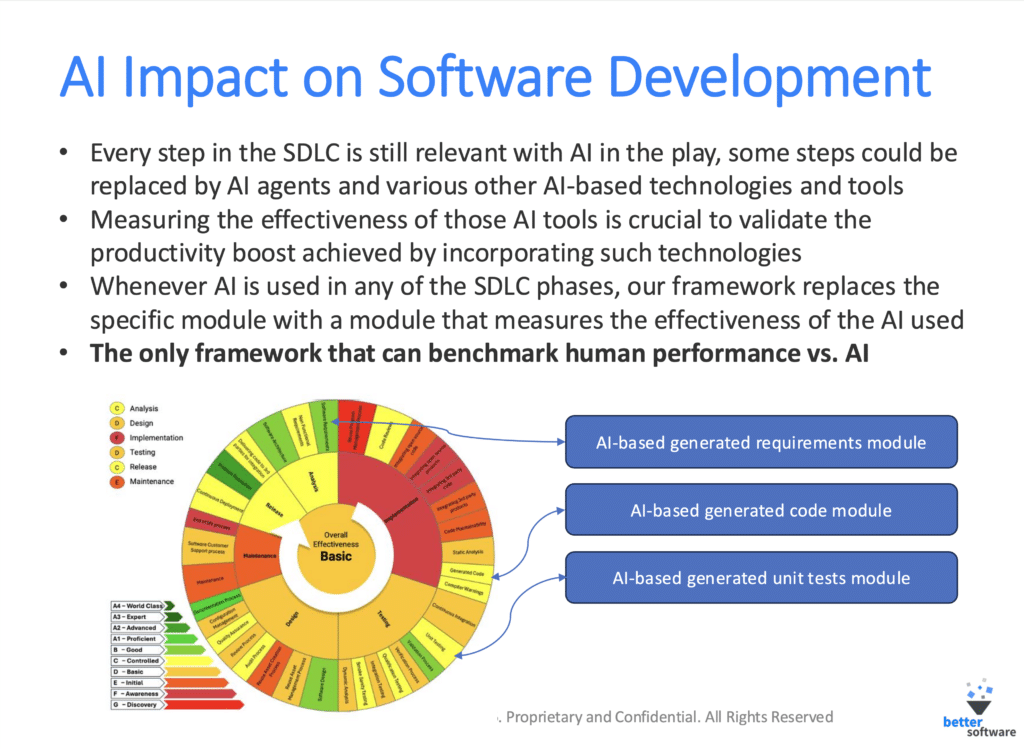
You can use AI is various phases of the Software Development Lifecycle (SDLC), see the image below. You can use it to generate requirements, generate architecture, design, code, testing and documentation. So why shouldn’t you?

Using AI comes with a price, first you have to invest in the tools and their subscriptions and more importantly, you have to put the right guardrails in place. If you’re using AI to generate the code, you need humans to perform the code review. If you’re using AI to generate Requirements, you need someone to review them before you spend a lot of time and money trying to build them, test them and get them in front of a paying customer

So, there are two questions that needs to be answered:

  1. Which phase in the SDLC is one that we need help with today?
  2. How will we measure the ROI for integrating AI into that phase?

If you ignore those questions, and choose an AI tool to generate code for you, you might find out (as many of our clients do) that code generation is not your main problem and that your technical debt is growing exponentially, your team is spending more and more time coping with it and the ROI is not clear at all.

So, the right way to do this, is first, analyze your SDLC and be thoughtful in detecting the areas which underperform (think, requirements, testing, CI/CD). There are many standard ways of doing that, our framework is one such way.

Once you understand where you’d like to use AI, choose the right tool, but more importantly, benchmark the current performance of the phase of the SDLC that you’re trying to boost, before and after. So you can quantifiably say what’s your ROI, in time, quality and pace

Again, there are standard ways to benchmark the performance of each phase in the SDLC, which is a topic for another article, but think about Customer Escapes, Code Review escapes, Test failure ratios, Build failure ratio. The important step is to have a clear benchmark before the AI tsunami hits the production floor

The Answer

AI Can do a lot to improve your team’s productivity. We’ve seen great examples of using AI as a Code Review enhancer, Defect Root Cause analyzer, Test Generation and more. But there are also many cases where adding those tools adds a lot of noise with marginal ROI.

The answer is, as always, a bit complex. You have to be super clear: which phase you’re trying to boost and how will you measure ROI. 

Once you answer that, start experimenting and enjoy the ride!
knowledge hub

Related articles

Challenges in Digital Transformation | BetterSoftware

Software Development Life Cycle – Reference Material for Further Reading

Digital transformation is a crucial step for industries seeking to remain competitive in today’s rapidly evolving landscape. However, non-software industries often face unique challenges, including outdated systems, a lack of digital skills, and cultural resistance to change. This article explores these common hurdles and offers practical strategies to help businesses overcome them, from upskilling employees to modernizing legacy systems and prioritizing cybersecurity. By addressing these barriers head-on, industries can unlock the full potential of digital transformation and achieve long-term success.

Learn more
Challenges in Digital Transformation | BetterSoftware

Overcoming Common Challenges in Digital Transformation for Non-Software Industries

Digital transformation is a crucial step for industries seeking to remain competitive in today’s rapidly evolving landscape. However, non-software industries often face unique challenges, including outdated systems, a lack of digital skills, and cultural resistance to change. This article explores these common hurdles and offers practical strategies to help businesses overcome them, from upskilling employees to modernizing legacy systems and prioritizing cybersecurity. By addressing these barriers head-on, industries can unlock the full potential of digital transformation and achieve long-term success.

Learn more
Defect Reduction | BetterSoftware

Defect Reduction in 30 Minutes: Targeting the Root Causes of Inefficiency

Software defects can significantly derail development timelines and inflate budgets, often leading to hidden costs such as delayed releases, rework, and customer dissatisfaction. These issues not only impact the bottom line but also reduce developer productivity as they spend valuable time fixing recurring defects. High-profile defect issues, like those seen in major software releases, highlight the severe consequences of inadequate defect management. By adopting a systems approach to identify and address root causes, teams can differentiate between symptoms and actual problems, leading to more effective defect reduction. Implementing a 30-minute defect reduction process can provide quick wins, enhancing overall efficiency and fostering a culture of continuous improvement.

Learn more

Claim your free initial team
effectiveness scan

Let’s determine the best and most efficient path to software excellence together.

Align on the scope on a brief 20-minute call.

Your benefits:
What happens next?
1

We schedule a call at your convenience

2

We hold a discovery meeting

3

We run a complimentary proof of concept

Request Your Free Scan

Partner with us for software excellence success

Integrating AI into your Software Development Lifecycle – The Answer