Would Your Software Engineering Organization Pass a World-Class Benchmark?
Welcome to this week’s newsletter!
When engineering executives evaluate their organizations, they often rely on activity metrics—story points completed, pull request volume, code coverage percentages, or developer tool usage. However, high activity frequently disguises severe operational waste.
World-class software organizations operate under a fundamentally different paradigm. They don’t measure whether their teams are busy; they measure whether their engineering processes are effective.
To determine whether your software delivery engine operates at a world-class standard or is caught in “improvement theatre,” here are 5 concrete, data-backed tests every engineering leader should run across their Software Development Lifecycle (SDLC).
Test 1: Can you quantify where defects are injected rather than just where they are found?
Most teams log hundreds of bugs during QA cycles or post-release escalations, treating detection points as the origin of the problem. However, defects can only be injected at three specific phases:
- Requirements (misleading, incomplete, or contradictory scope)
- Design & Architecture (structural flaws or unscalable patterns)
- Implementation (actual coding or logic errors)
The World-Class Standard: You must calculate your Escape Ratios at the end of every iteration. By auditing a sample of defects during retrospectives, your experts identify where each bug was created and calculate your Requirement, Design, and Code Review Escape Ratios. If your requirement escape ratio exceeds 15%, your team is wasting millions building the wrong things.
Test 2: Can every team demonstrate measurable improvement iteration over iteration?
It is common for teams to implement new Agile ceremonies, hold retrospectives, and still produce the exact same volume of bugs sprint after sprint.
The World-Class Standard: Under a quantitative framework, progress must be trended and verified.
- At Controlled maturity, a team tracks the primary KPI for a specific competency (such as Code Review Escape Ratio or Build Pass Rate) and demonstrates a flat or improving trend across iterations.
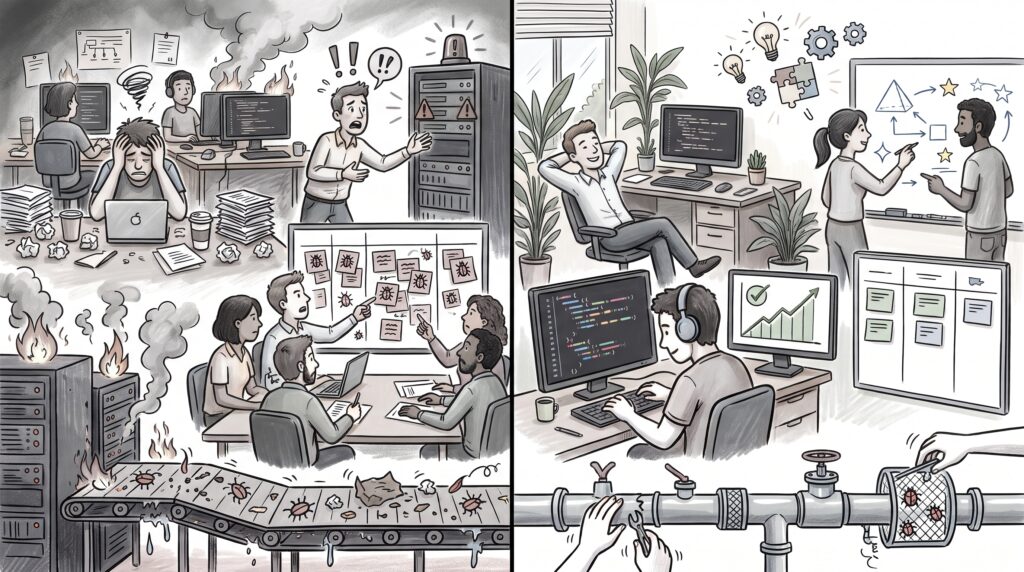
- At Good maturity, teams master the “Fixed at Injection” principle—issues are caught and resolved within the exact station where they are created, preventing defects from rolling forward into testing or release branches.
Test 3: Can you quantify the financial cost of rework in your R&D budget?
The financial cost of a defect grows exponentially with the gap in time between its point of injection and its point of detection. A logic error caught during a peer code review costs almost nothing; that same error escaping to production as a customer escalation can cost $10,000+ in emergency hotfixes, reputation management, and lost velocity.
The World-Class Standard: Low-effectiveness teams spend 50% to 75% of their total engineering capacity fixing defects and managing technical debt. High-effectiveness teams use upstream quality gates to catch issues at injection, reducing defect overhead to less than 25% of team capacity and freeing up 10% to 15% more R&D bandwidth for value-generating features.
Test 4: Do you know which specific SDLC competency is currently constraining delivery performance?
Many transformation initiatives fail because leaders engage in “spray improvement”—investing in expensive new tools or broad process mandates without knowing if that area is actually their delivery bottleneck. For example, spending $100k on AI coding assistants when your true bottleneck is requirement ambiguity only accelerates the rate at which you build the wrong features.
The World-Class Standard: Modern software delivery spans many distinct competencies across Analysis, Design, Implementation, Testing, Release, and Maintenance. A world-class organization uses an objective competency heatmap to isolate its single weakest link, focusing 100% of its improvement budget on resolving that specific constraint before moving to the next.
Test 5: Can you demonstrate that AI adoption has improved an outcome rather than just increased usage?
The industry is currently facing a “Code Generation Trap”. Industry data shows that while AI tools have increased individual developer Pull Request volume by 98%, overall organizational software delivery has dropped by 1.5% because unmanaged code generation inflates review overhead and debugging time.
The World-Class Standard: You must benchmark AI tools against human engineers on outcomes, not activity. In a structured pilot, assign AI agents a portion of the workload and compare human vs. AI performance across three objective metrics:
- Cost: Engineering labor hours vs. infrastructure/token expense.
- Time to Completion: Duration required to meet the pipeline’s Definition of Done.
- Accuracy (Yield): Downstream defect escape rates caught by human-in-the-loop quality gates.
How Does Your Organization Score?
If your organization cannot confidently answer these 5 tests with hard data, you are likely losing up to 40% of your R&D capacity to preventable rework and late-stage defect escapes.
To help engineering leaders establish a clear baseline, BetterSoftware offers an objective SDLC Team Scan. We evaluate your engineering delivery across all 35 competencies, produce a visual effectiveness heatmap, and identify the top 3 high-impact bottlenecks standing between your team and world-class performance.
Until next week, keep measuring what matters!