When Customer Escalations Go Away
Welcome to this week’s newsletter!
In many software organizations, the engineering calendar is not dictated by sprint planning or product roadmaps, it is dictated by production fires.
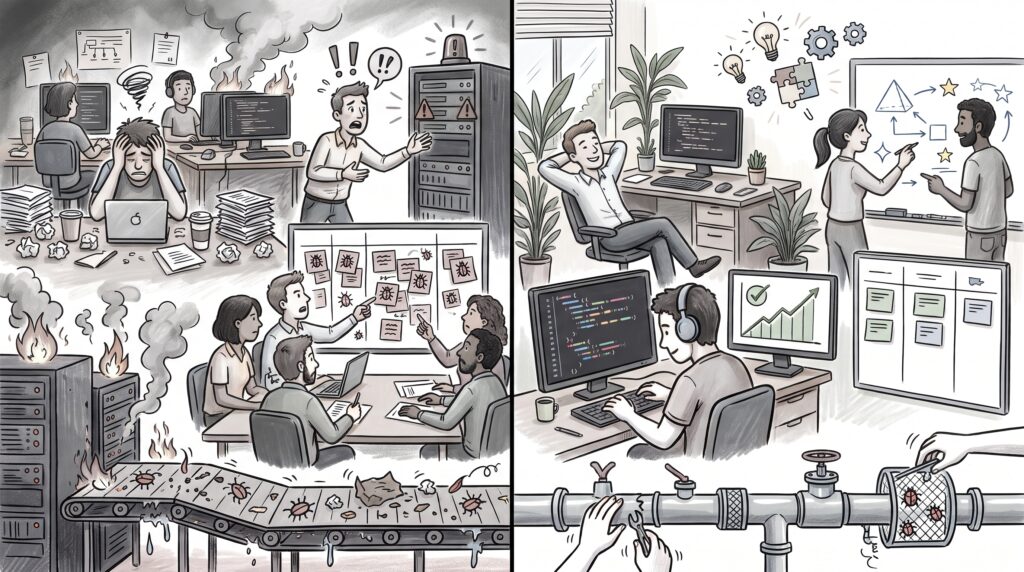
When release quality is unstable, the everyday reality of engineering becomes a grind of unplanned context switching: emergency triage meetings, duplicate bug investigations, urgent rollback calls, and weekend firefighting.
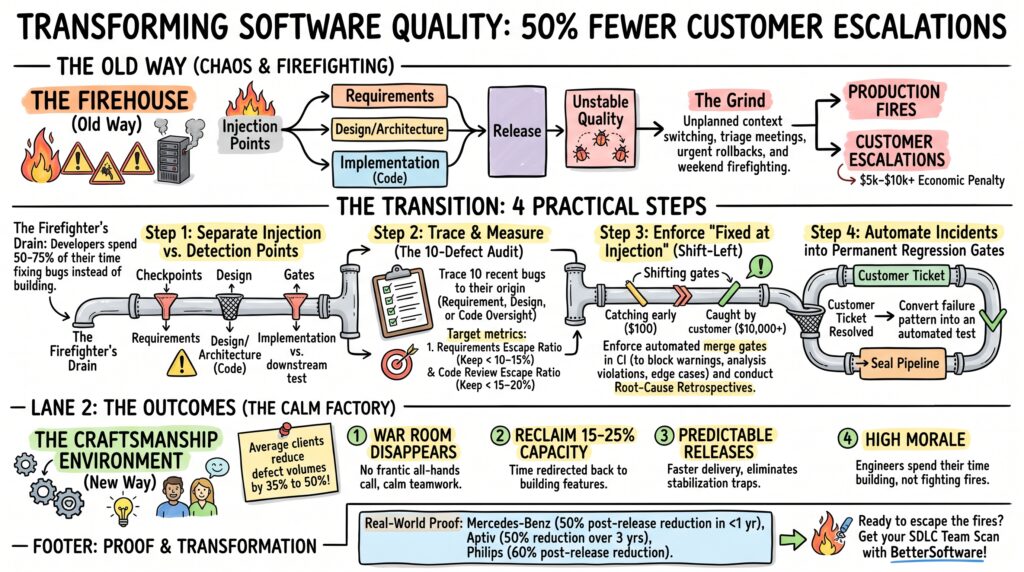
As we close out 2026, our client implementations across automotive, healthcare, and enterprise tech have achieved an average 35% reduction in incoming defect counts, with mature organizations reaching 50% reductions in defect volume and post-release issues.
What does that mathematical shift actually look like on the ground—and how do engineering teams get there?
Read On!
What Changes in Everyday Engineering Life?
When customer escalations drop by 50%, the entire culture and operational tempo of an engineering organization transforms:
1. The Disappearance of the “War Room”
In low-effectiveness organizations, finding 1,000 defects in an internal test cycle almost mathematically guarantees that roughly 10% or 100 customer escalations, will leak into production. Each customer escalation carries an outsized economic penalty of $5,000 to $10,000+ in emergency patches, stakeholder management, and reputation loss.
When you cut that leakage in half, the frantic “all-hands” incident calls vanish. As one Executive Vice President at an industrial client observed after transforming their engineering gates: *“I’m not called into customer escalation calls anymore; the bugs just went away”*.
2. Reclaiming 15% to 25% of “Invisible” Headcount
In typical software teams, developers spend 50% to 75% of their total working hours triaging defects, managing technical debt, and fixing bugs. In a 1,000-person organization, this often means 600 developers work full-time just fixing issues created by the other 400.
When defect volume drops by 35% to 50%, team time spent on defect rework falls to **less than 25%–35%**. This instantly frees up 10% to 25%+ of engineering capacity—allowing the same team to build and deliver new feature scope without hiring additional headcount.
3. Predictable Releases Without Month-Long “Stabilization” Traps
Teams trapped in reactive firefighting operate under a “deliver now, fix later” mindset, forcing organizations into lengthy late-stage stabilization cycles that can delay market delivery by months. Slashing defect escapes eliminates the crunch period, resulting in 15% to 30% faster delivery times and predictable release schedules.
4. Higher Developer Morale and Retention
Engineers want to build software, not spend their careers wading through vague reproduction steps, rerouting Jira tickets, and writing emergency hotfixes under executive pressure. When teams transition from firefighting to craftsmanship, developer retention and engagement rise significantly.
4 Practical Steps to Get There
Slashing customer escalations does not require hiring an army of QA testers or buying expensive new tool suites. It requires re-engineering how defects are handled across your software pipeline:
Step 1: Separate Injection Points from Detection Points
Defects can only be injected into software at three specific stations: Requirements, Design/Architecture, and **Implementation (Code)**. Conversely, detection points are endless (code reviews, unit tests, integration pipelines, and customers). Customer escalations are never a “customer support” problem; they are upstream requirement, design, or implementation flaws that slipped through every downstream gate.
Step 2: Measure Fast Lagging Escape Ratios
Stop waiting for quarterly customer satisfaction surveys to tell you quality is slipping. Run a 10-defect audit in your iteration retrospectives:
Sample 10 recent bugs logged in your issue tracker.
Trace each bug to its origin: Was it a vague requirement, a structural design oversight, or a coding mistake?
Ask: *”Could this have been detected during the initial requirement review or code review?”*
Divide detectable escapes by total bugs analyzed to establish your Requirement Escape Ratio (keep below 10%–15%) and Code Review Escape Ratio (keep below 15%–20%).
Step 3: Enforce “Fixed at Injection”
The cost of fixing a bug grows exponentially with the time gap between its point of injection and its point of detection. A logic error caught during code review costs under $100; that same error discovered by a customer costs **$10,000+**.
Shift verification upstream: enforce automated merge gates in CI that block compiler warnings, static analysis violations, and unhandled edge cases before code merges.
Whenever a defect escapes into testing or production, don’t just patch the bug—conduct a root-cause retrospective to fix the process gap in your review checklists or automated checks so that specific pattern cannot escape again.
Step 4: Automate Customer Incidents into Permanent Regression Gates
Every customer-reported issue represents a scenario your internal automated test suites failed to anticipate. Whenever a customer ticket is resolved, turn that failure signature into a permanent automated regression test in your CI/CD suite before closing the issue. Over time, this systematically seals the pipeline against recurring defect categories.
Stop Letting Defects Drive Your Roadmap
Escalation firefighting is not an inevitable reality of software delivery, it is simply the symptom of an uncalibrated factory floor. By measuring station escape ratios and catching defects at injection, you can cut customer escalations in half and give your engineers their time back to build what matters.
Ready to benchmark your organization’s delivery pipeline and identify where defects are escaping? BetterSoftware provides an objective SDLC Team Scan that evaluates your practices across 35 core competencies and highlights your top 3 high-impact improvement opportunities
Until next week, keep measuring what matters!