Speed vs. Quality in the AI Era
Welcome to this week’s newsletter!
As engineering organizations race to adopt coding agents and automated workflows, it is easy to assume that the fundamental rules of software management have been rewritten. In reality, balancing time-to-market, customer satisfaction, and cost in the AI era is not much different than it was before.
Good software still rests on the same three business pillars: delivering to market quickly, keeping customers satisfied with high quality, and keeping development costs under control.
Now, let’s run a quick thought experiment. Assume your costs are fixed, your engineering headcount is stable, and your AI model provider pricing is stable for now (even though token costs carry the ongoing risk of uncontrolled provider price hikes).
With cost held constant, you are left managing the classic tension between time-to-market and customer satisfaction, in other words, speed and quality.
AI Is Definitely Faster. What About Its Quality?
There is no debate that AI-based development accelerates raw output. Code, requirements, and tests can be generated in minutes.
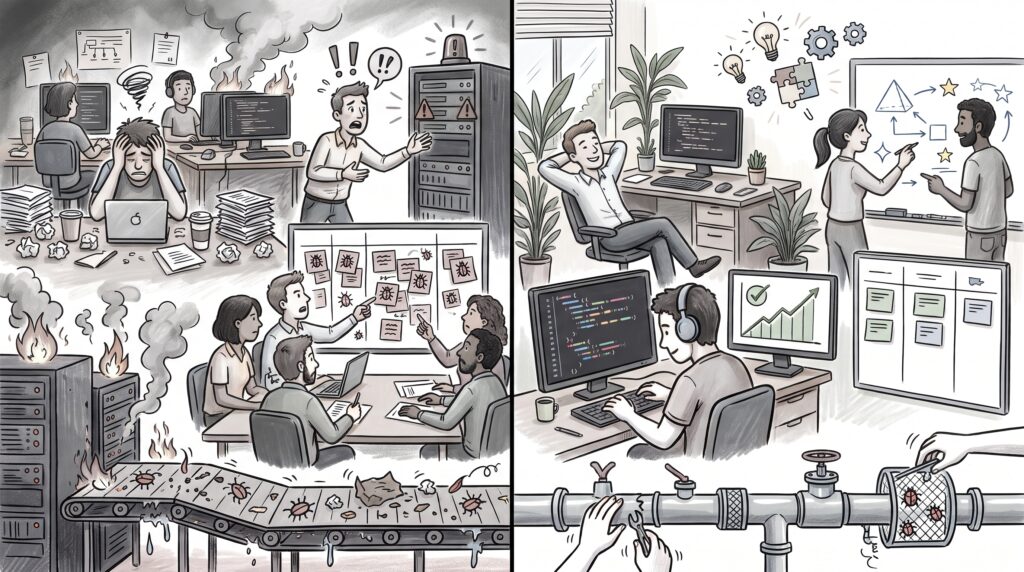
The danger is assuming that faster generation automatically equals better delivery. When AI generates code in five minutes, it bypasses the natural human thinking process, the back-and-forth refinement with product managers that catches contradictions and edge cases early. Without strict design controls and supervision, small daily errors compound like a 1-degree deviation on a ten-day sea voyage: by day ten, you have missed the island entirely. In practice, teams that let AI run loose often see debugging times balloon by up to 80% because developers are left troubleshooting synthetic code they did not write.
AI will always win on speed, which is exactly why your organization must obsessively measure quality.
Two Proven Strategies to Govern Agentic Engineering
To capture AI speed without sacrificing customer satisfaction, engineering leaders need structured governance. Two practical strategies stand out:
1. Weaving: Alternating AI Execution with Human Guardrails
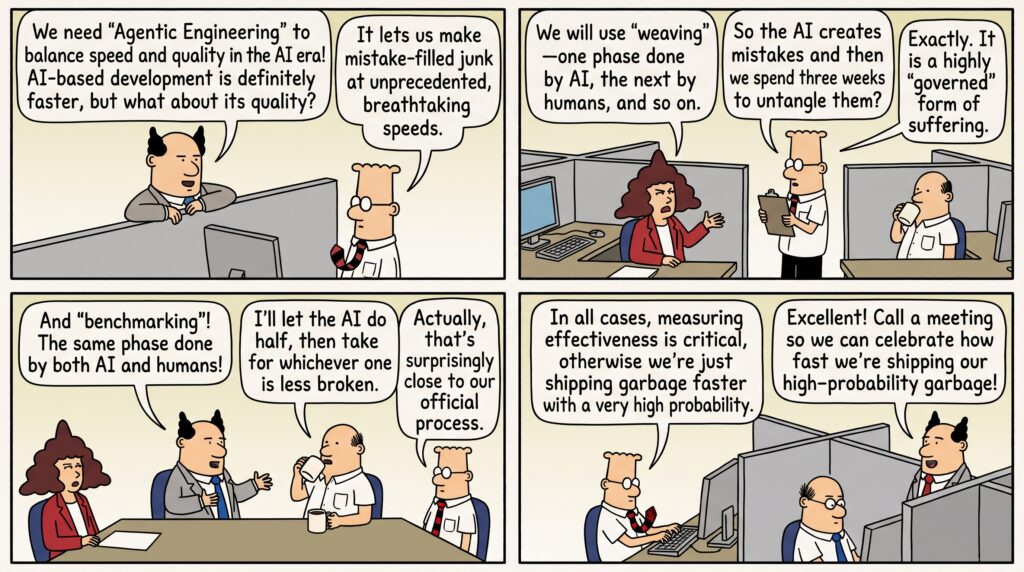
Instead of handing an entire end-to-end workflow to autonomous agents, weave AI and human oversight across consecutive SDLC phases. When an AI agent executes one phase, the very next phase must act as a human-in-the-loop quality guardrail:
AI writes requirements → Humans run the requirement review against a formal checklist for clarity, dependencies, and testability.
AI generates code → Humans own the code review, evaluating maintainability, static analysis, and logic.
AI generates tests → Humans validate assertion depth and review downstream defect patterns.
By weaving humans into the next station, you catch AI deviations before they roll forward and contaminate the rest of the pipeline.
2. Benchmarking: Running AI and Humans Side-by-Side
Never scale an AI tool on vendor promises or gut feel. Instead, run AI and human engineers on the exact same SDLC phase to objectively compare their performance:
Pick a target phase where your team is currently feeling delivery pain.
Define a clear quality gate (such as static analysis rules, review checklists, or test pass criteria).
Split the workload, assigning roughly half to the AI agent and half to human engineers.
Benchmark both on three metrics:
Cost: Human labor hours versus AI token and infrastructure costs.
Time to Completion: How long each takes to satisfy the phase’s Definition of Done.
Accuracy (Yield): How many artifacts pass the quality gate versus how many are rejected or escape downstream.
Your industry dictates what you optimize for: a consumer app may prioritize raw speed, while automotive or healthcare teams must prioritize accuracy because the cost of a recall or safety issue is too high. Only when the AI consistently outperforms your human baseline under the exact same quality gates should you gradually reallocate your engineers to higher-value work
The Bottom Line: Measure Every SDLC Phase
Whether a phase is executed by human engineers, AI agents, or both, measuring the effectiveness of each SDLC station is no longer optional.
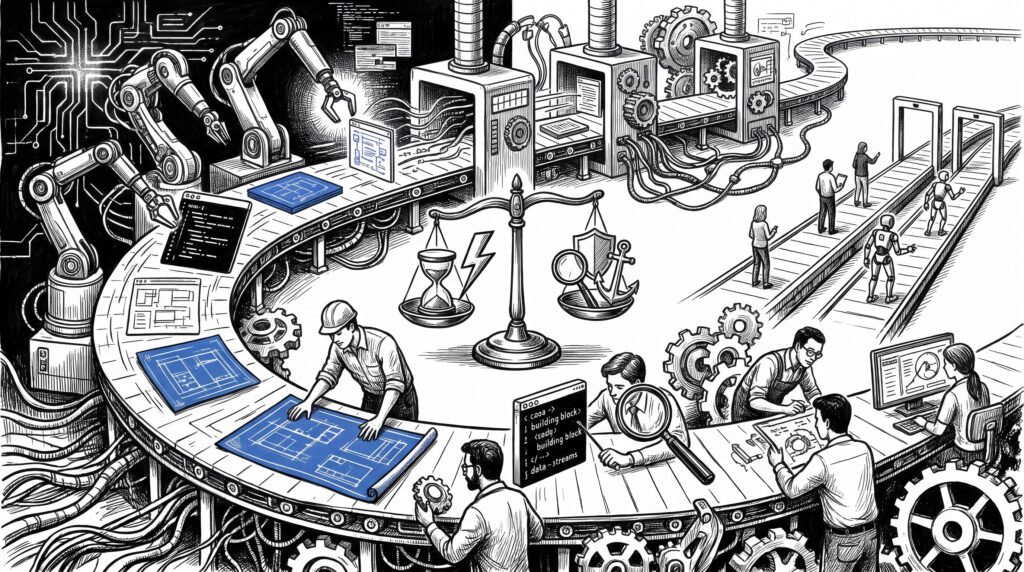
Think of your SDLC as a manufacturing line where every station has a measurable yield. Because leading activity metrics (like PR volume or comment counts) are easily gamed, the most reliable way to govern each phase is through fast lagging indicators, specifically Escape Ratios. By auditing downstream defects and asking “Could this have been caught at the previous station?”, you get immediate, objective feedback on whether your AI-assisted phase is actually working.
Without phase-level measurement, agentic engineering doesn’t make you better, it just makes it highly probable that you are shipping faster with lower quality.
Until next week, keep measuring what matters!